
Construction Foreman Manager Cover Letter Examples That Work in 2026
Most candidates simply list tasks. Hiring managers, however, want to see clear evidence that you can manage people, schedules, and on-site decisions simultaneously. These examples show how to frame that from the very first lines.
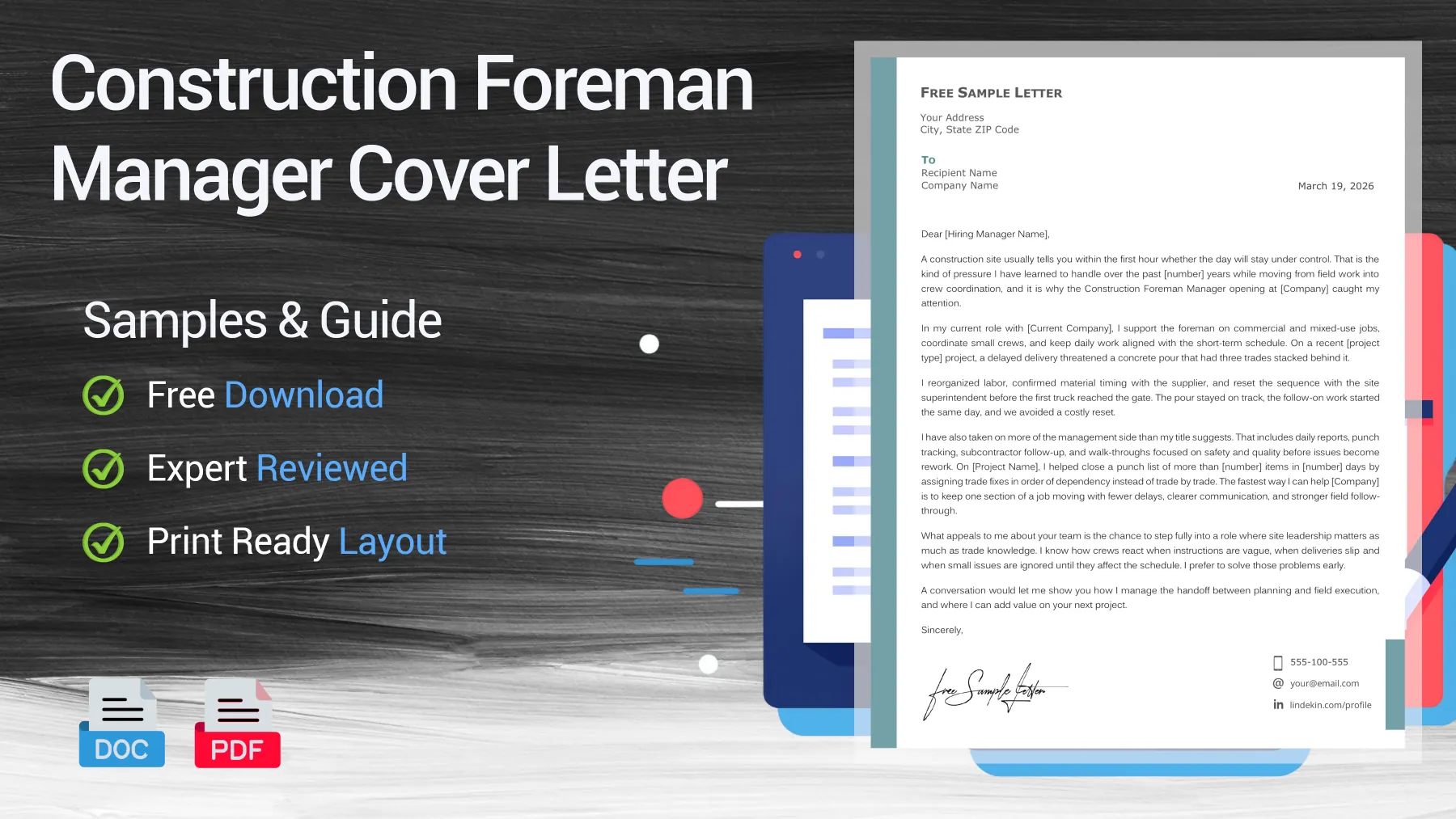
Free Samples for Construction Management Applications
According to the U.S. Bureau of Labor Statistics, construction manager jobs are projected to grow 9% from 2024 to 2034. The key: show leadership, schedule control, and budget judgment, not just trade experience.
Junior Construction Foreman Manager Cover Letter Sample
Built for a junior construction foreman manager profile with 2 to 3 years on site, this sample turns early leadership, crew support, and jobsite follow-through into a credible application letter.
Dear [Hiring Manager Name],
You can usually tell within the first hour on site whether the day will stay on track. Over the past [number] years, as I moved from field work into crew coordination, I have learned to handle that kind of pressure. That is why the Construction Foreman Manager position at [Company] caught my attention.
In my current role with [Current Company], I support the foreman on commercial and mixed-use jobs, coordinate small crews, and keep daily work aligned with the short-term schedule. On a recent [project type] job, a delayed delivery threatened a concrete pour with three trades stacked behind it.
I reorganized labor, confirmed material timing with the supplier, and reset the sequence with the site superintendent before the first truck reached the gate. The pour stayed on track, the follow-on work started the same day, and we avoided a costly reset.
I have also taken on more management than my current title suggests. That includes daily reports, punch tracking, subcontractor follow-up, and walk-throughs focused on safety and quality before issues become rework. On [Project Name], I helped close out a punch list of more than [number] items in [number] days by assigning trade fixes based on dependency, not just by trade. The fastest way I can help [Company] is by keeping a section of work moving with fewer delays, clearer communication, and stronger field follow-through.
What draws me to your team is the opportunity to take on a role where site leadership is as important as trade knowledge. I have seen how crews react when instructions are unclear, deliveries fall behind, or small issues escalate into real schedule impacts. I try to solve those problems before they grow.
A conversation would let me show you how I manage the handoff between planning and field execution, and where I can add value on your next project.
Sincerely,
[Your Name]

Reviewed by Robert H., Technical Recruiter
I notice that the letter does not hide junior status. It earns credibility by showing sequencing decisions, field awareness, and immediate usefulness.
Senior Construction Foreman Manager Cover Letter
Written for an experienced construction foreman manager, this application letter shows how long-term field leadership, planning discipline, and quality control support hiring decisions.
Dear [Hiring Manager Name],
When a project starts to drift, the warning signs are rarely dramatic. They show up in labor loading, unfinished handoffs, late approvals, and small quality issues that ripple through the schedule. Over more than [number] years on ground-up, renovation, and multi-phase projects, I have built a record of catching and fixing these issues early, which is why I am interested in the Construction Foreman Manager role at [Company].
In my current position with [Current Company], I lead field operations across [number]- to [number]-person crews, coordinate subcontractors, and keep work tied to production targets rather than wishful planning. On [Project Name], I inherited a site that was behind on framing, carrying open safety observations, and losing time to unclear trade sequencing.
I rebuilt the three-week look-ahead, reassigned manpower by critical path, and ran short morning coordination huddles with trade leads. Within [number] weeks, we recovered [number] days, closed the open items, and moved into the next phase without adding weekend labor.
My approach is disciplined because a manager’s job is not just to push production. It is to protect cost, quality, and predictability at the same time. I maintain that balance through daily walks, documented punch priorities, quantity checks before key pours or installs, and direct communication with project management when field conditions affect procurement or scheduling.
I protect the quality of my work by checking the next handoff before the current crew leaves the area. That habit has saved time on finishes, inspections, and client walk-throughs more times than I can count.
I am interested in [Company] because this role clearly calls for hands-on site leadership, not just a desk title. That fits how I work. Crews need direction they can use immediately, and project managers need field information they can trust.
If a discussion is useful, I can walk you through the systems I use to keep jobs moving, crews accountable, and closeout cleaner.
Sincerely,
[Your Name]
Reviewed by Robert H., Technical Recruiter
I rate this sample highly because it connects manpower, schedule recovery, and quality control in one coherent management story that feels earned.
Internal Promotion Cover Letter for a Construction Manager Role
Designed for a foreman moving up inside the same company, this application letter frames internal experience as management readiness, not simple familiarity.
Dear [Manager Name],
I know what this company expects from a site leader because I have seen the work from inside, not just from a brochure. That is why I am applying for the Construction Foreman Manager position at [Company]: I already see where stronger coordination, earlier reporting, and clearer crew direction make the biggest difference.
In my current role, I am still close to the tools and the daily rhythm of the site, but my responsibilities have expanded well beyond that. I help prepare the daily work plan, coordinate with trade leads, track incomplete items, and speak up when the sequence on paper will not hold up in the field.
On [Project Name], I noticed that a planned handoff between two trades was going to fail because access, materials, and cleanup were not aligned. I raised it before the shift started, helped reset the order of operations, and kept the area ready for the next crew by the afternoon. Small intervention, big effect.
What prepares me for management is not just seniority. It is the way I already focus on manpower, timing, accountability, and follow-through. Colleagues come to me for field answers, and I understand what project managers need from the site: reliable updates, fewer surprises, and honest reporting when something goes off plan. That balance is essential in a manager role.
I would bring continuity, but not complacency. Moving into management inside the same company only works when the person can shift from being one of the crew to being responsible for the whole operation in that area. I am prepared for that shift.
A meeting would give me the opportunity to explain how I would handle the change in authority, the communication flow, and the day-to-day leadership this role requires.
Sincerely,
[Your Name]
Reviewed by Robert H., Technical Recruiter
I like this version because it captures the real challenge of an internal move: keeping field credibility while stepping into broader accountability.
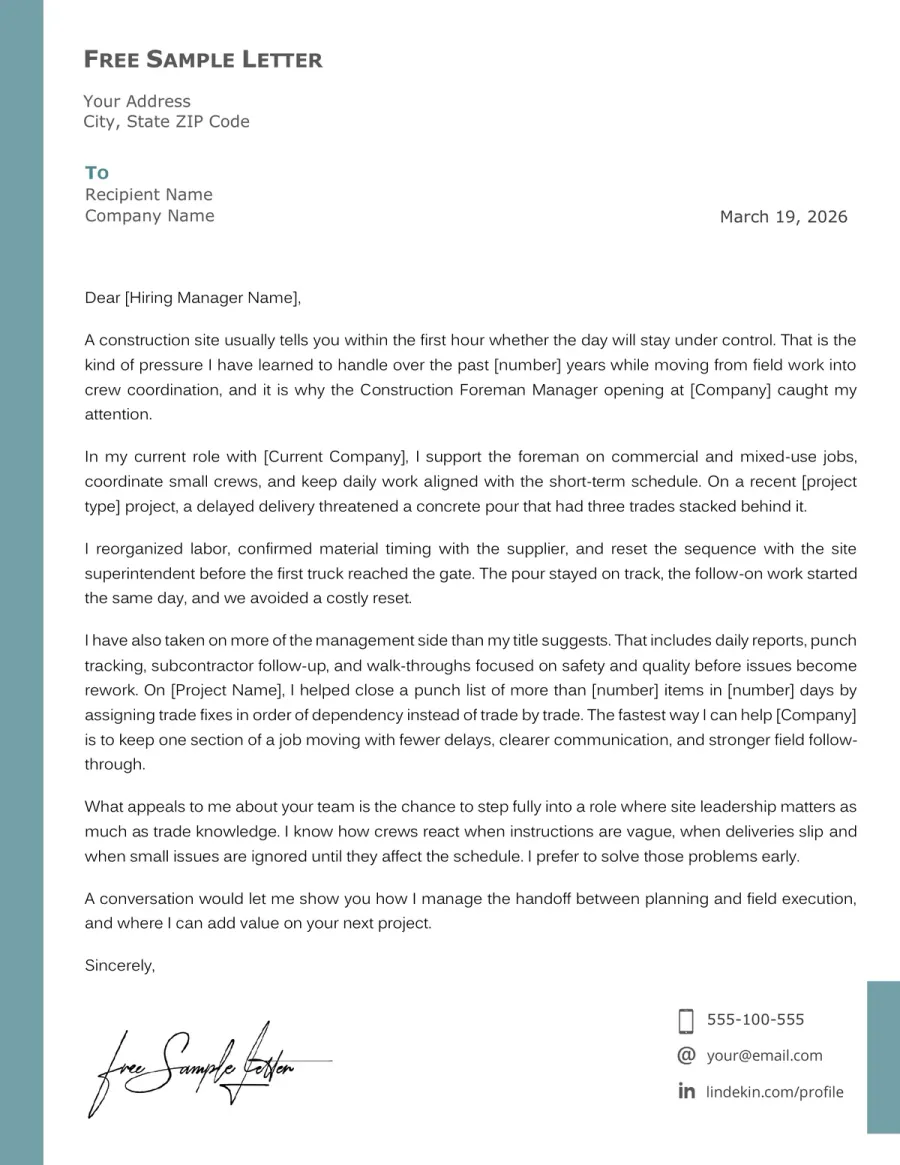
Preview This Construction Management Template Before Word or PDF Download
Review the construction foreman manager template before downloading it in Word or PDF. This sample allows you to check both the layout and the letter’s wording before you commit.
Turn These Templates Into Your Own Letter in 5 Steps
Copy-pasting weakens a construction management letter quickly. Hiring teams spot vague project stories, exaggerated titles, and generic leadership phrases right away. Use the structure, but update the examples, project details, and jobsite language to match your own experience.
➡️ More expert guidance in our article how to tailor a cover letter without sounding generic
Match the real scope
Start by clarifying the level of responsibility. A foreman manager letter should demonstrate crew direction, sequencing, safety follow-up, and reporting. If it sounds like a laborer role, the whole application loses impact.
See an example
“On [Project Name], I coordinated [number] workers across framing, delivery, and inspection prep, keeping the next trade ready instead of waiting for issues to pile up.”
Replace generic leadership claims
Do not just say you are organized, reliable, or hands-on. Connect each claim to a real site action, like reallocating labor, updating the day plan, closing punch items, or preventing early delays.
See a stronger line
“When a delivery slipped on [Project Name], I moved one crew to a prepared area, reordered the sequence, and kept the inspection window intact.”
Adjust the project reality
Your sample should reflect your real work. Swap in the correct project type, crew size, trade mix, reporting habits, and pressure points. A hospital fit-out does not read like a housing site.
See how it sounds
“Most of my experience comes from tenant improvement work, where short schedules, occupied spaces, and tight subcontractor windows leave no room for vague instructions.”
Use the right management language
A strong draft blends field language with management terms. Mention look-aheads, subcontractor follow-up, work timetables, budget awareness, drawings, or code compliance where they fit naturally.
See a useful phrase
“I tracked progress against the three-week look-ahead, flagged material gaps early, and reported anything likely to affect cost or handoff timing.”
Finish with a real next step
Your closing should sound like a real site conversation, not a template ending. Point to the next useful step: project delivery, field coordination, staffing approach, or the first weeks in the role.
See a better ending
“I would welcome the chance to discuss how I would organize manpower, reporting, and subcontractor coordination during the first phase of your next project.”
Construction Foreman Manager Keyword Radar
- RFIs
- Crew supervision
- Budget tracking
- Site sequencing
- Reading blueprints
- Keeping trades aligned during schedule pressure
- Change order follow-up
- Daily progress reporting
- Subcontractor coordination
- Safety and code compliance
- Client-facing progress updates and issue reporting
- Work timetables and labor allocation
Do & Don't - What Makes This Letter Credible
For this role, recruiters read each letter like a quick site briefing. They look for signs of control: crew leadership, sequencing, handling delays, subcontractor coordination, budget awareness, and clear reporting. Unsubstantiated confidence loses impact immediately.
What weakens the letter fast
Red Flags- List duties with no project scope
- Claim leadership without proof
- Sound like a general labor applicant
- Ignore safety, codes, or subcontractor coordination
- Overload the page with generic confidence words
What makes the letter believable
Trust Signals- Name the project type and level of responsibility
- Show how you handled delays, sequencing or handoffs
- Blend field language with management language
- Mention reporting, budget follow-up or documentation
- Close with a practical discussion about site delivery
FAQ - Construction Foreman Manager Cover Letter
Should my letter sound like a foreman letter or a project manager letter? Toggle answer
It should sound like someone who can run field execution and report upward. Keep the site language, but add schedule control, subcontractor coordination, handoffs, and progress reporting.
Is OSHA 30 worth mentioning if the posting does not ask for it? Toggle answer
Yes, when it reflects real jobsite habits. Mention it briefly, then connect it to inspections, toolbox talks, stop-work judgment, or cleaner safety follow-through.
I have strong field experience but limited budget responsibility. How do I handle that? Toggle answer
Do not fake budget ownership. Show what you really controlled: labor allocation, material timing, delay prevention, change impacts, or cost-conscious sequencing. Honest scope reads stronger than inflated claims.
I am applying for an internal promotion. Should I mention that I already know the crews? Toggle answer
Yes, but do not make it your main argument. What matters more is that you understand your company’s workflow, reporting rhythm, and the standards expected on the job.
Most of my work is residential. Will that hurt me for a commercial construction management role? Toggle answer
Not if you tailor your examples. Commercial employers look for strong coordination, clear documentation, subcontractor management, inspection readiness, and schedule discipline. Keep the structure, but update your examples to reflect commercial work.
TL;DR - What Makes a Construction Foreman Manager Cover Letter Land
A strong construction foreman manager cover letter proves three things quickly: you can direct crews, keep work moving when sequencing breaks down, and report progress like someone trusted above the field. The fatal mistake is sounding too generic or too much like a labor-only profile.
The real difference is not just years. It is range. Recruiters look for candidates who move from site details to management judgment without losing credibility. A short, specific example about handoffs, delays, subcontractors, or inspections usually carries more weight than a long paragraph about leadership.