
Mason Cover Letter Examples That Sound Ready for the Job in 2026
Hiring managers quickly recognize vague mason cover letters. These examples help you demonstrate site discipline, material knowledge, and reliable work habits without sounding scripted or generic.
Free Mason Cover Letter Samples for Job Applications
The BLS reports about 20,700 masonry openings per year, with most masons learning through apprenticeships or on-the-job experience. In other words, your letter should demonstrate real site habits, not just interest in the trade.
Junior Mason Cover Letter for a First Full-Time Role
Written for a recent masonry trainee, this application letter shows how to speak about supervised practice, safe material handling, and reading simple plans without overselling experience.
Dear [Hiring Manager Name],
A masonry crew relies on more than just strength. It needs someone who can follow layout, protect materials, and keep the work moving without creating extra steps for the team. That is why I am applying for the mason role at [Company Name] after completing my training at [School or Apprenticeship Program].
I will not claim to be a finished tradesperson yet. What I bring is recent, supervised field training and work habits that help a new hire become useful quickly. During my apprenticeship, I mixed mortar to spec, prepared brick and block for the next lift, checked dimensions with the lead mason, and kept the work area clear so cutting and setting could continue safely.
When deliveries arrived out of order on one site, I stepped in to re-sort materials by size and placement zone. The crew lost less time than expected, and it showed me how much good organization improves production.
My training also included reading basic plans and learning how measurements on paper become lines on the ground. I assisted with straight runs, corners, and surface prep on small jobs, checking alignment with level and line before asking for sign-off.
That routine helped me spot small errors early. It also taught me to ask questions before a mistake turns into demolition.
If [Company Name] needs someone with ten years of experience, I know that is not me. But if you are looking for someone teachable, steady, and already comfortable with site discipline, tools, and crew pace, I can help sooner than my résumé might suggest. I would welcome the chance to talk about your current workload and how I could support your team from the first week.
Sincerely,
[Your Name]

Reviewed by Robert H., Technical Recruiter
I like the honesty here. It admits the candidate is still new, then answers that concern with site discipline, layout support, and solid habits.
Senior Mason Cover Letter for Stonecutting and Restoration Work
Created for a senior mason with stonecutter expertise, this sample puts finish quality, restoration judgment, and technical process at the center of the application.
Dear [Hiring Manager Name],
Stonecutting leaves no room for guesswork. When a piece is off, the mistake is visible. That standard has guided my work for more than [number] years, and it is why I am interested in the senior mason position at [Company Name].
My background is in stone fabrication, restoration, and installation. On recent projects, I used shop drawings and site measurements to cut limestone and granite units for façades, steps, and custom exterior details.
Before installation, I verify every piece by checking dimensions, dry fitting when needed, and matching edge treatments to the surrounding work. This approach reduced recuts on one restoration project from weekly issues to just [number] pieces during the final phase, keeping both schedule and material waste under control.
Field conditions can change quickly, especially on renovation jobs. I have worked with uneven substrates, out-of-line older walls, and stone deliveries with natural variation.
On a church repair project, several replacement units arrived with slight color and size differences. I re-sequenced the setting order, adjusted the visible joints, and hand-finished two pieces on site so the repaired section blended with the original elevation. The architect approved the solution without asking for further replacement.
I also bring crew judgment. I can read elevations, coordinate with laborers and operators, and maintain safety alongside finish standards. My fastest value to [Company Name] is stepping into complex stone work, protecting quality before it becomes a cost issue, and helping younger masons develop their eye for layout and finish. I would be glad to discuss your current stone or restoration projects in more detail.
Respectfully,
[Your Name]
Reviewed by Robert H., Technical Recruiter
I would move this applicant forward fast. The process around checking fit, reducing recuts, and protecting finish quality sounds senior and credible.
Mason Trainee Application Letter for an Apprenticeship Placement
This apprenticeship sample is made for a candidate seeking formal masonry training. It proves readiness through manual habits, safety awareness, and a real willingness to learn.
Dear Hiring Manager,
What attracts me to masonry is not just the image of the trade. It is the discipline behind it: measuring carefully, setting each course with purpose, and learning from people who know when a wall is truly right. That is why I am seeking an apprenticeship with [Company Name].
I am at the start of this path, so I will not claim experience I do not have. What I do have is a record of taking practical work seriously. At [School Name] and through personal projects, I have spent time with basic tools, reading simple dimensions, mixing materials correctly, and learning why preparation matters before any visible result appears.
In one workshop, a small error in the first line threw off the entire layout. I chose to redo the setup from the start rather than patch over it, and that decision improved the final result far more than rushing ahead would have.
Another reason I am pursuing apprenticeship is that I value direct correction. I want to learn from experienced masons, not from guesswork. The fastest way I can help [Company Name] is by showing up ready for the unglamorous part of the trade: loading in, staging materials, cleaning joints, checking levels, and handling the repetitive tasks that let skilled workers keep production moving.
I am used to physical work, punctual schedules, and being accountable for small details.
If an apprenticeship place becomes available, I would welcome a meeting or site visit to show how I approach hands-on learning. Masonry is the trade I want to commit to, and I would rather start by earning trust on the ground than by making claims I have not yet proved.
Sincerely,
[Your Name]
Reviewed by Robert H., Technical Recruiter
I would remember this letter because it stays honest about inexperience while showing the exact support tasks that help a crew trust a beginner.
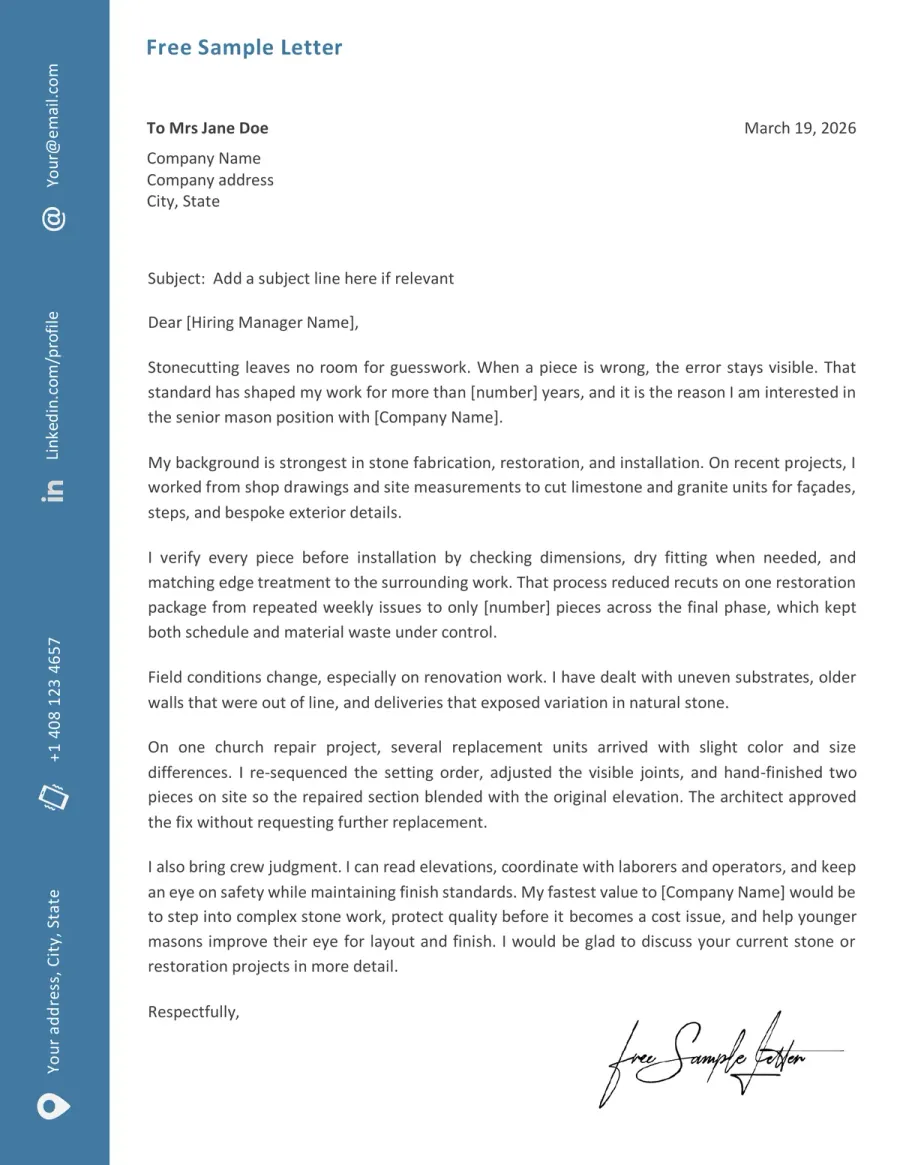
Mason Cover Letter Template Preview Before Word and PDF Download
Preview the mason cover letter template before downloading it in Word or PDF. This layout lets you review the structure, tone, and flow of the letter before choosing your preferred file format.
Turn These Mason Templates Into Your Own Letter in 5 Steps
Copy-paste letters usually miss the mark for masonry jobs because they sound disconnected from real site work. Tailor the trade focus, tools, job type, and work habits so your letter matches actual crews, materials, and the specific role.
➡️ More expert guidance in our article how to write a cover letter that sounds real to hiring managers
Match the role to the right masonry lane
Start by choosing the right focus: brick, block, stone, cement, restoration, or apprenticeship. Recruiters quickly notice when a letter is written for a different type of construction role.
See Open a targeting example
I am applying for the mason opening at [Company Name] with a background focused on blockwork, site preparation, and layout support rather than general construction duties.
Replace generic claims with site proof
Remove vague statements about being hardworking or motivated. Instead, describe a specific job-site action the reader can envision, like setting out, mixing mortar correctly, reading drawings, staging materials, or correcting alignment issues.
See what to include
During my apprenticeship at [Training Company], I prepared mortar, checked levels with the lead mason, and staged the next run of block so the crew could keep moving.
Add the right trade vocabulary
The strongest letters sound specific without trying to impress. Mention the tools, materials, or plan-reading tasks you genuinely know, and keep the language appropriate to your experience level: trainee, experienced mason, or stone specialist.
See sample wording
I am comfortable working with levels, jointers, trowels, and basic masonry saws, and I have learned to follow simple drawings before starting layout work.
Set the right voice for the role
Do not use the same voice for every sample. A junior profile should sound eager to learn and support the crew, while a senior profile should sound ready to solve problems efficiently and quietly.
See the shift in tone
I am looking for the chance to learn under experienced masons and become useful quickly through reliable site habits and careful follow-through.
Close like someone ready for the work
Your closing lines should be practical, not ceremonial. A grounded ending leaves the reader with a clear sense that you understand the job and are ready to discuss real work.
See Open a final example
I would be glad to speak about the mix of brick, block, or stone work on your current sites and where my experience could add value first.
Keyword Radar for Mason Hiring Managers
- Set-out
- Blueprint reading
- Stone repair and restoration work
- Blockwork
- Safe use of cutting tools
- Wall alignment and joint finish
- Site safety
- Bricklaying
- Clean work area between phases
- Hand tools
- Stonecutting
- Working from line and level
Do & Don't for a Mason Cover Letter That Sounds Credible
For masonry roles, recruiters have one main question: will this person make life easier on site or harder? Your letter carries more weight when it references real work, actual crews, and specific standards instead of broad construction talk.
Mason Cover Letter Red Flags
Red Flags- Lean on vague lines about being hardworking
- Sound like a general labor applicant with no masonry angle
- List soft skills without one site example
- Use the same tone for apprenticeship and senior roles
- Name tools or techniques you could not discuss in person
Mason Cover Letter Trust Signals
Trust Signals- Name the kind of masonry work you know best
- Mention drawings, layout, levels, materials, or cutting only when true
- Write at the level of responsibility the job actually requires
- Make the reader feel how you support quality, pace, or finish
- Close with a practical next step linked to current projects
FAQ - Mason Cover Letter
Can I apply for a mason apprenticeship if I only have school, workshop, or labouring experience? Toggle answer
Yes, just be honest about your background. Highlight site habits such as measuring carefully, mixing materials correctly, keeping the area clean, following instructions, and working safely. This is much more credible than pretending you have already worked as a full mason.
Should I call myself a mason, bricklayer, or stonemason in the letter? Toggle answer
Start by using the job title from the vacancy. Then clarify your specialty in one sentence. This helps the reader quickly understand whether your background is in brick, block, stone, restoration, or general masonry support.
Is blueprint reading worth mentioning if I only helped with layout under supervision? Toggle answer
Yes, but be honest. Say you have assisted with simple drawings, measurements, line, or level checks. This shows you understand how plans translate into site work without overstating your independence.
For a stonecutting role, should I focus on speed or finish quality? Toggle answer
Finish quality matters most. In stonework, visible accuracy outweighs claims about speed. Mention fit, clean edges, joint consistency, or how you minimize recuts and material waste.
I am moving from general construction into masonry. What proof matters most? Toggle answer
Show how your experience connects to masonry. Mention material handling, site safety, reading measurements, tool care, and a specific moment where your preparation helped the crew. This gives your move real weight instead of sounding like a vague career switch.
TL;DR - What Makes a Mason Cover Letter Worth Reading
A strong Mason Cover Letter earns trust with site proof: the materials you handled, the drawings you followed, the finish quality you protected. Name your masonry lane clearly. The fatal mistake is sending a generic construction letter that never proves actual masonry judgment.
Recruiters read for control. They want to feel that you understand pace, alignment, safety, and how small errors spread across a wall, step, or facade. Even a junior profile gains credibility when the letter shows measured work, clean setup, and a closing that sounds ready for a real site conversation.