
Skills & Qualifications Resume Template for Transferable Experience
This skills and qualifications resume template helps you highlight transferable strengths, relevant achievements, and a range of experience in a clear, credible format. It is designed for candidates who need a professional resume or CV layout that is easy to scan and even easier to tailor, especially when skills take priority over a strict work timeline.
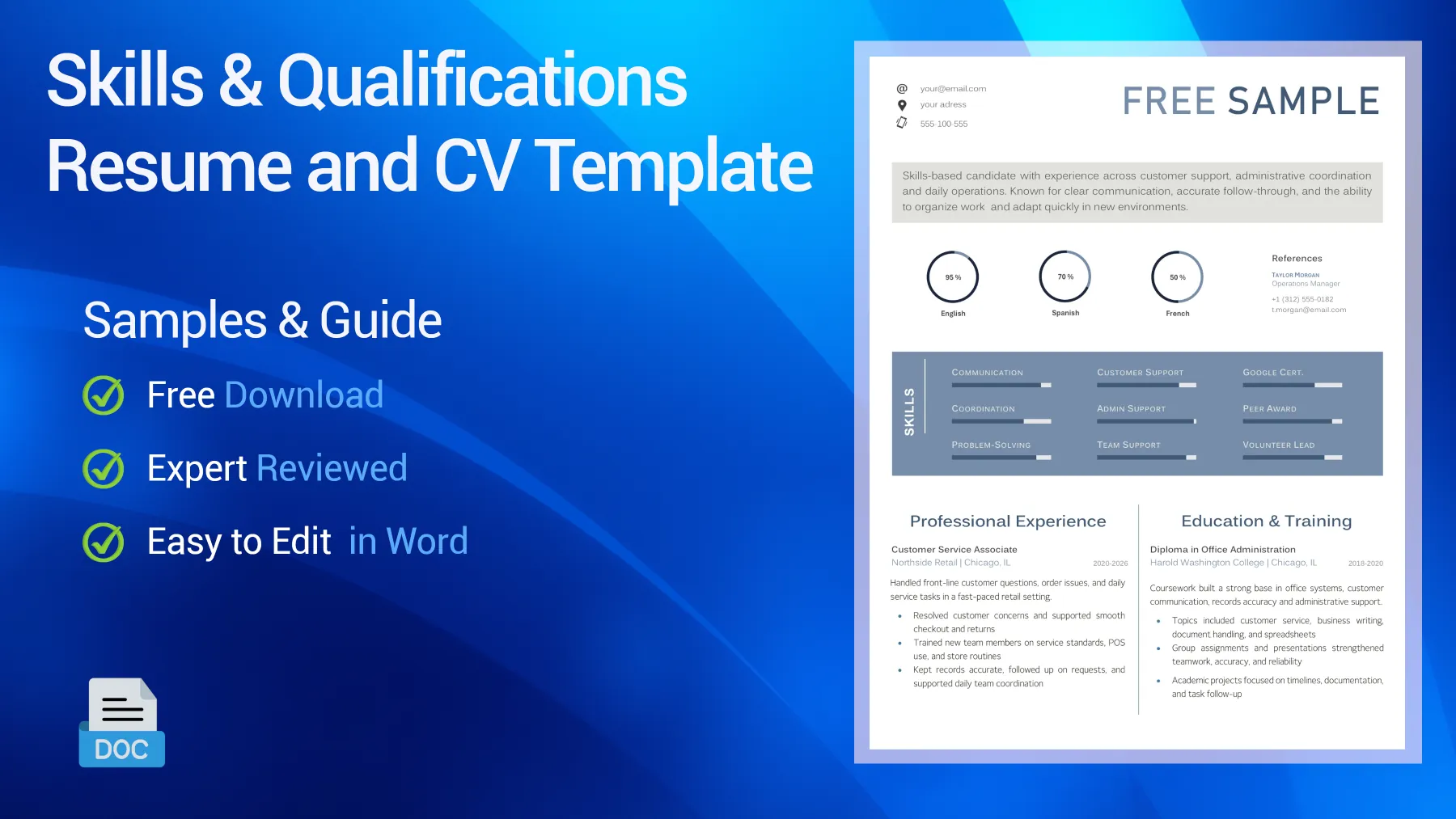
Table of Contents
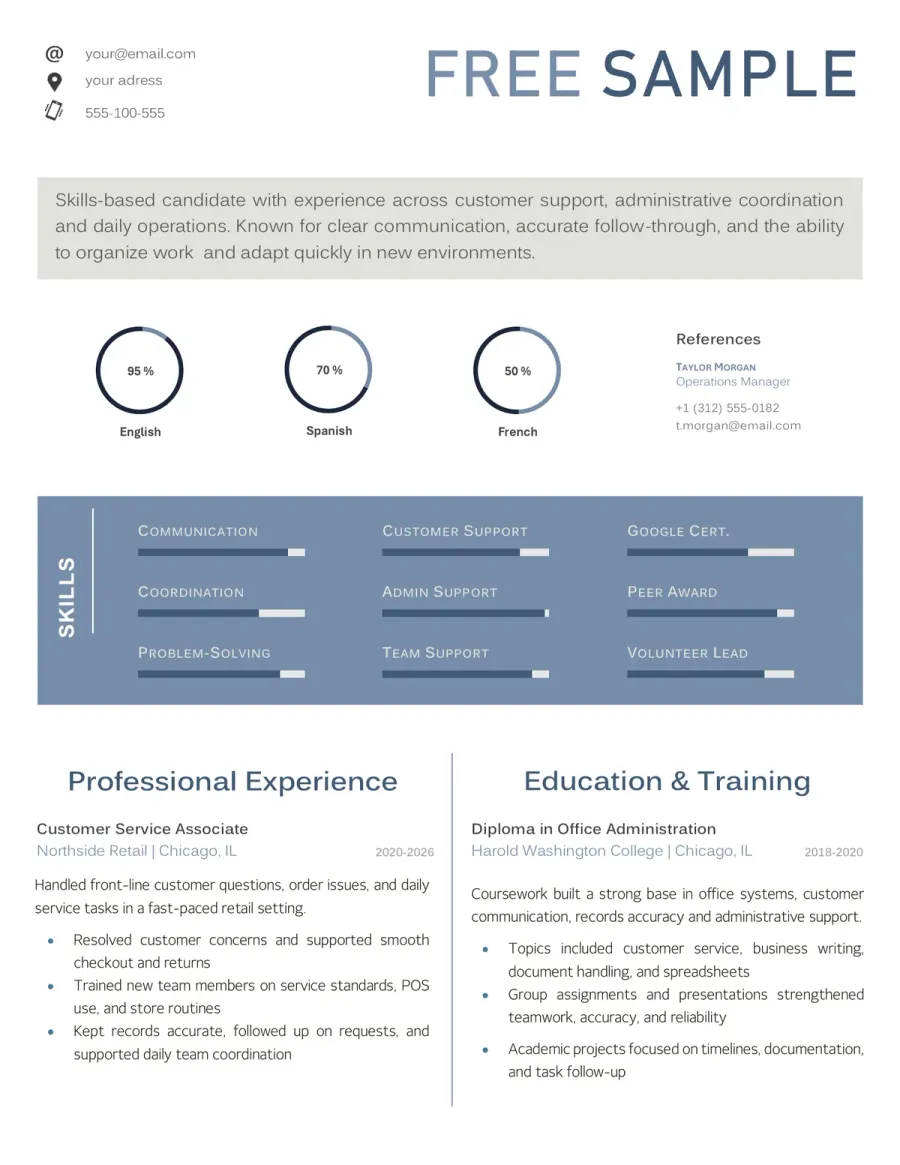
Preview of the Free Skills & Qualifications CV Example You Can Download
Use this editable skills-based resume template if you want a layout that puts qualifications, transferable strengths, and relevant achievements at the top. This resume and CV format is well-suited for career changers, return-to-work candidates, applicants with limited experience, or people with mixed backgrounds. Review the structure, then download the Word version and tailor it to your own experience.

Reviewed by Daniel K., Resume Consultant
This layout works because it presents real value up front, rather than making the reader sift through a weak or uneven timeline. It is especially effective for applications where transferable skills matter and recruiters need to quickly see what the candidate can offer.
Who This Skills & Qualifications Resume Template Works Best For
This template is ideal for candidates whose strongest asset is not a perfectly linear work history. Whether you call it a resume or a CV, it is most effective when recruiters need to see qualifications, practical strengths, and relevant examples before reviewing your timeline.
- Career changers who need a clearer resume for transferable skills, qualifications, and experience that comes from a different field.
- Candidates with employment gaps who want a stronger CV that leads with what they can do, instead of letting the timeline dominate the first impression.
- Return-to-work applicants who need to reconnect older experience, home responsibilities, volunteering, training, or side projects to a current job target.
- Students and recent graduates whose qualifications, projects, coursework, and activities are more valuable than a short or fragmented work history.
- Applicants with mixed backgrounds across freelance work, volunteering, temporary jobs, contract roles, or personal projects who need one format that pulls the strongest threads together.
- Candidates targeting a new level or adjacent role who need to prove communication, leadership, coordination, problem-solving, or technical strengths before job titles tell the full story.
How to Adapt This Skills & Qualifications Resume Template
A skills-based resume only works when it feels targeted, not evasive. The strongest versions do not hide your timeline; they organize your document around the most relevant qualifications and abilities, then support those with concrete examples from work, volunteering, study, projects, or other experience.
➡️ For more advice, read our guide on how to write a strong CV
Choose the target role before you group the skills
A skills-based CV should not be a generic list of qualities. Start by deciding what role you are targeting, then identify the 3 to 4 skill areas that matter most for that position before you write anything else.
See an example
If the role is project coordination, lead with planning, communication, stakeholder follow-up, and problem-solving. If it is customer-facing, push service, conflict handling, systems use, and reliability higher.
Build each skill section with real proof
Do not just write a heading like Leadership or Organization and leave it at that. Each skill area should include evidence drawn from work, volunteering, coursework, side projects, family responsibilities, or any experience that shows the skill in action.
See What to prioritize
Training new staff, organizing schedules, resolving customer issues, leading student projects, managing volunteer tasks, or keeping records accurate all work better than isolated skill words.
Keep a short work history instead of hiding it
A skills-based resume should usually include a brief employment section. This makes the document feel more credible and easier to follow. Keep the timeline concise, but do not remove it entirely unless there is a clear reason.
See Better phrasing
A short employment section with job title, employer, and dates is often more effective than a resume that never explains where your experience came from.
Use target keywords naturally inside the skill blocks
This type of resume is much stronger when your language matches the job description. Use the vocabulary of the job posting in your skill headings, examples, and tools section, so recruiters can quickly connect your background to the target role.
See Quick rule
For admin roles, use scheduling, records, coordination, and customer communication. For operations, push workflow, reporting, team support, and problem-solving higher.
Keep the tone grounded and believable
A skills-based CV should feel focused, not defensive. Do not exaggerate your level just because the structure is different. The strongest versions sound practical, honest, and relevant, using clear examples to back up each claim.
See Good direction
Instead of “dynamic leader with broad expertise,” say “candidate with strong coordination, customer communication, and problem-solving skills built through retail, volunteering, and project work.”
Keywords Recruiters Often Expect on This Type of Resume
- Transferable skills
- Project coordination
- Problem-solving
- Customer communication
- Team leadership
- Time management
- Training and onboarding
- Cross-functional collaboration
- Administrative support
- Process improvement
- Data accuracy
- Conflict resolution
- Volunteer experience
- Academic projects
- Client-facing experience
- Relevant achievements
- Technical skills
- Organizational skills
- Role-specific tools
- Professional summary
Do & Don’t - What Makes a Skills-Based Resume Easier to Trust
Recruiters often respond quickly to this format because it can feel smart and focused or, when done poorly, vague and evasive. The strongest versions connect transferable skills to real examples, clear targets, and enough timeline detail to stay credible.
What Weakens This Type of Resume Fast
Red Flags- Using generic skill headings with no proof underneath
- Hiding the timeline so completely that the reader loses trust
- Listing soft skills without examples, outcomes, or context
- Grouping unrelated experiences under broad labels that mean little
- Ignoring the language and priorities of the target role
What Makes the Resume Feel Stronger Immediately
Trust Signals- Choose 3 to 4 skill clusters that clearly match the target job
- Support each section with examples from work, study, volunteering, or projects
- Keep a brief work-history anchor when it helps the reader trust the profile
- Repeat the target role’s keywords naturally across skills and examples
- Keep the layout clean, focused, and easy to scan in under a minute
FAQ - Skills-Based CV Template
Is a skills-based resume good for a career change? Toggle answer
Yes. That is one of its strongest uses. It helps you lead with transferable strengths instead of letting older job titles or industry labels control the first impression.
Can I use this template if I have employment gaps? Toggle answer
Yes. It works well when gaps might otherwise dominate the page. The key is to focus on relevant skills and proof while still keeping enough timeline detail to feel credible.
Should I still include my work history on a skills-based CV? Toggle answer
Usually, yes. Even a brief employment section helps ground your resume. The main difference is that your strongest skill clusters come first, while the timeline becomes secondary rather than central.
Does this type of resume work with ATS tools? Toggle answer
It can, as long as you keep the structure simple and include relevant keywords, job titles, tools, and language related to the role. Overdesigned or abstract skill sections can actually make your document less effective.
Can I use this format with little direct experience? Toggle answer
Yes. It is often useful for candidates whose value comes from projects, volunteering, study, side work, or mixed experience rather than a long, direct professional track.
Can I edit this resume template in Microsoft Word, LibreOffice or Google Docs? Toggle answer
Yes, in most cases. The template is designed for easy editing in Microsoft Word, but you can also use it in LibreOffice or Google Docs. Minor spacing or font differences may appear depending on the software.
What to Do Next With This Resume Template
A strong skills-based resume or CV should quickly show the reader what you can do, not just where you have worked. Keep the layout focused, lead with strengths that match your target role, and avoid using this format to hide weak details. Instead, use it to organize and highlight your strongest points.
With this kind of application, credibility comes from clear proof. Recruiters notice when your resume highlights transferable skills, relevant examples, practical tools, and a believable link between your past experience and your next target role. That is what gives a skills-based resume real impact.