
Retirement Congratulations Letter and Email Examples for an Employee
A retirement message should celebrate the person, not just the milestone. These examples help you thank an employee, recognize their contribution and close with sincere good wishes.
Before You Send a Retirement Congratulations Letter
A retirement congratulations letter is both recognition and farewell. Before writing, confirm the employee’s role, years of service, major contributions, team impact, retirement date and whether the message will be private, public, formal or read aloud at an event.
Keep the tone respectful and specific. A strong employer message does not require exaggerated praise. One real contribution, one human detail and a warm closing often feel more sincere than a long list of generic compliments.
Be careful with sensitive details. Do not mention health, age, performance issues, internal disagreements, succession plans or private retirement plans unless the employee has clearly shared them and the context makes it appropriate. If the message will be spoken at a retirement event, use a separate speech format rather than turning a letter into a toast.
Retirement Congratulations Letter From an Employer
A warm yet professional retirement congratulations letter from an employer that recognizes years of service and a positive company legacy.
Dear [Employee Name],
On behalf of [Company Name], I congratulate you on your retirement and thank you for your many years of dedicated service to our organization.
Since joining us in [Year], you have consistently contributed to [department / project / area of responsibility] with care and professionalism. Your work on [specific project, responsibility or achievement] has made a lasting difference to the team and the people who have worked with you.
We will remember not only your experience, but also the way you shared it. Your patience, reliability and willingness to support colleagues have set a standard that will continue long after your last day.
We hope this next chapter brings you the time, freedom and satisfaction you have earned. Please accept our sincere appreciation for your service, along with our very best wishes for your retirement.
With warm congratulations,
[Your Name]
[Your Position] [Company Name]

Reviewed by Michael T., Business Communications Consultant
This letter is effective because it recognizes the employee’s contribution without exaggeration. The tone is appreciative, formal and genuinely human.
Retirement Congratulations Email From a Manager
A concise retirement congratulations email from a manager when you want to thank a team member personally without sounding too formal.
Subject: Congratulations on your retirement
Hi [Employee Name],
I wanted to send you my warmest congratulations on your retirement and thank you for everything you have brought to [Team / Department].
Working with you has been a privilege. Your knowledge of [area of work], your steady approach to [responsibility] and the support you have given colleagues have made a lasting difference across the team.
I especially appreciate [specific example: the way you trained newer team members / your work on a key project / your calm handling of difficult situations / your reliability during busy periods].
I hope retirement gives you time for [general wish: family, travel, rest, personal projects or new interests], and that you look back on your career here with pride.
Thank you again, and congratulations on reaching this well-earned milestone.
Best wishes,
[Your Name]
Reviewed by Michael T., Business Communications Consultant
This email is useful when a manager wants a personal tone. It is concise but includes enough detail to avoid sounding generic.
Retirement Congratulations Letter From the Team
A collective retirement farewell letter from colleagues for a card, group email or message signed by a department.
Dear [Employee Name],
All of us in [Team / Department] want to congratulate you on your retirement and thank you for the years you have spent working alongside us.
You have been a steady part of this team through [brief shared context: busy seasons, major projects, changes, growth or challenges]. Many of us have learned from your experience, your practical advice and your careful approach to work.
We will miss your presence, your knowledge and the small everyday things that made working with you easier. Whether it was [specific team memory] or the way you always made time to help, your contributions have meant a great deal to all of us.
As you begin this new chapter, we hope you enjoy every part of the freedom you have earned. Please know that you leave with our respect, gratitude and warmest wishes.
Congratulations on your retirement,
[Team / Department Name]
Reviewed by Michael T., Business Communications Consultant
This team version feels natural because it speaks as a group, uses a shared memory and avoids making one person’s retirement sound like a corporate announcement.
Formal Retirement Appreciation Letter for a Long Career
A formal retirement appreciation letter for a long-serving employee, senior colleague, director or valued professional.
Dear [Employee Name],
We extend our sincere congratulations on your retirement from [Company Name] after [Number] years of dedicated service.
Throughout your career with us, you have contributed to [business area / department / mission] with professionalism, judgment and commitment. Your work has supported [specific achievement, client service, operational improvement, team growth or company milestone], and your influence is reflected in the people and processes you helped shape.
Your retirement marks the close of an important chapter and gives us an opportunity to recognize the standard you have set. Colleagues have valued your knowledge, reliability and ability to approach work with both seriousness and generosity.
On behalf of [Company Name], please accept our sincere thanks for your service and our warmest congratulations. We wish you health, happiness and fulfillment in the years ahead.
Respectfully,
[Your Name]
[Your Position] [Company Name]
Reviewed by Michael T., Business Communications Consultant
This formal version is appropriate for senior or long-serving employees. It recognizes both legacy and contribution without becoming overly sentimental.
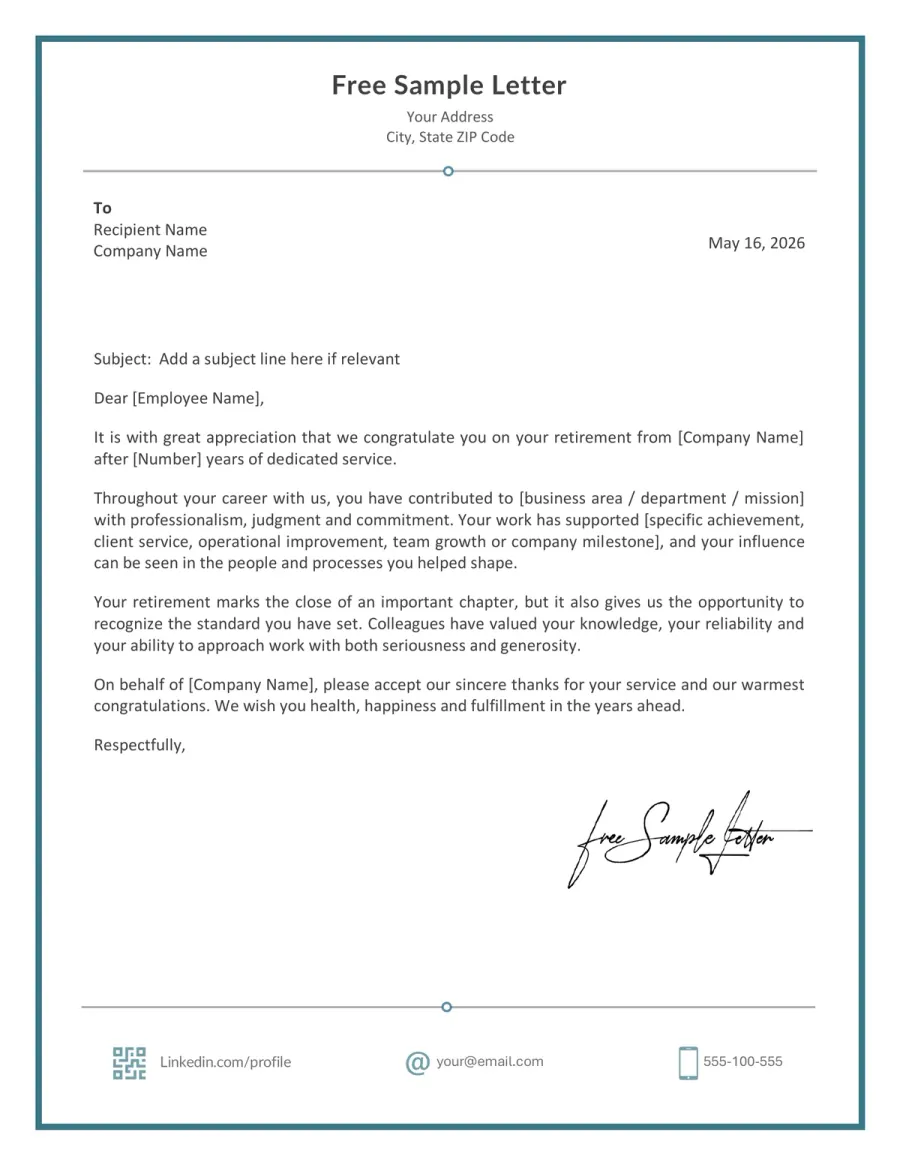
Preview of the Free Retirement Congratulations Letter Template
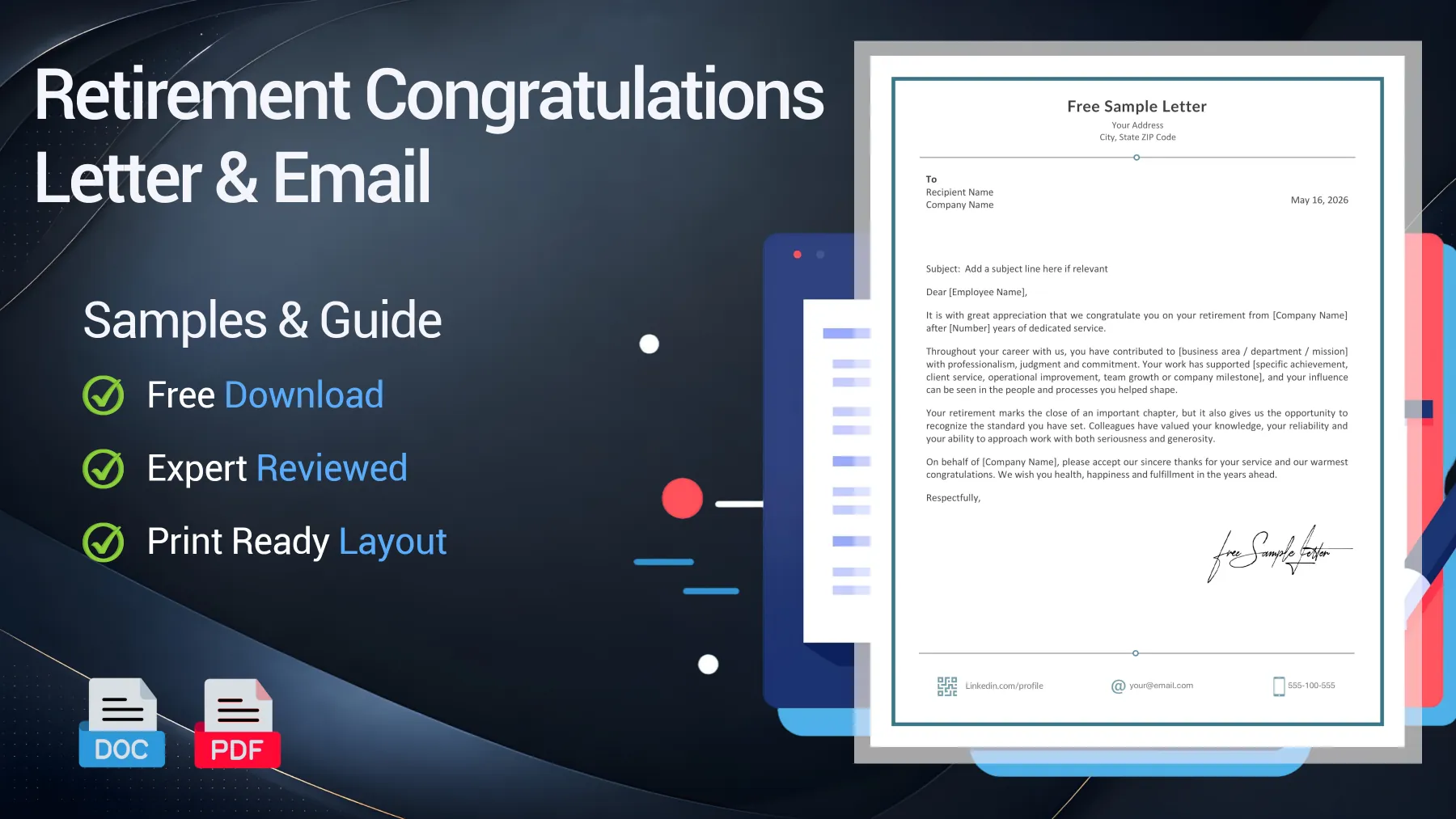
Use the preview to check the structure before downloading the editable version. The template makes appreciation, career recognition, team impact and retirement wishes easy to adapt.
How to Write a Retirement Congratulations Letter
A strong retirement congratulations letter should feel personal and specific to the employee. Start by acknowledging the milestone, recognize their contribution, mention one real example when appropriate and close with warm wishes for the next chapter.
➡️ More practical help in our guide how to write a professional letter that sounds personal and clear
Start with congratulations and the retirement milestone
Open by naming the retirement clearly and warmly. If the employee is leaving after resignation rather than retirement, use a resignation acceptance letter from an employer instead.
See a clear opening
On behalf of [Company Name], I would like to congratulate you on your retirement and thank you for your years of service.
Recognize the contribution with one specific detail
Mention a specific project, responsibility, team quality, customer impact or period of service. Specific recognition feels more sincere than a general statement about hard work.
See recognition wording
Your work on [Project / Department / Responsibility] has made a lasting difference to the team.
Match the tone to the sender
An employer letter can be formal, while a manager email may be warmer and a team card can include a shared memory. If the message will be spoken at an event, use a retirement farewell speech sample instead of a letter format.
See Why this helps
A letter works well as a written record or keepsake. A speech needs rhythm, audience awareness and natural delivery.
Avoid private or sensitive details
Do not mention age, health, family circumstances, performance issues or private retirement plans unless the employee has clearly made those details public.
See a safer approach
“We wish you happiness and fulfillment in the years ahead” is safer than referring to personal plans the employee may not want shared.
Close with appreciation and a forward-looking wish
End by thanking the employee and wishing them well. Keep it warm, not dramatic. If the employee is new rather than leaving, a new employee welcome email is the better HR message.
See a clean closing
Please accept our sincere appreciation for your service and our warmest wishes for your retirement.
What to Include in a Retirement Congratulations Letter
- Employee Name
- Retirement Milestone or Date
- Years of Service, if Appropriate
- Role and/or Department
- Specific Contribution or Achievement
- Team Impact or Influence
- One Shared Memory, if Suitable
- Thank-You Message or Note
- Best Wishes for Retirement or the Next Chapter
- Sender Name and Title
Do & Don’t - Retirement Congratulations Letter
A retirement message should feel respectful, personal and appropriate for the workplace. The best messages recognize the person’s contribution without sharing private details.
What Weakens the Message
Red Flags- Rely only on a generic congratulations line with no specific detail
- Mention age, health or private retirement plans without permission
- Turn the letter into a long performance review
- Make jokes that may not suit a formal workplace message
- Emphasize how difficult the employee will be to replace
- Confuse a written letter with a spoken retirement speech
What Makes the Message More Meaningful
Trust Signals- Clearly congratulate the employee
- Thank them for their service or contribution
- Mention one specific project, quality or shared memory
- Keep the tone appropriate to the sender
- Respect privacy and maintain workplace boundaries
- End with warm, forward-looking wishes
FAQ - Retirement Congratulations Letter
What should I write in a retirement congratulations letter? Toggle answer
Congratulate the employee, thank them for their contribution, mention one specific achievement or quality, and close with warm wishes for retirement. Keep the message sincere, professional and appropriate for your relationship with the employee.
Should a retirement letter be formal or personal? Toggle answer
It depends on who is sending the message. An employer or HR letter should remain polished and respectful. A message from a manager, team or colleague can be warmer and more personal, especially when it includes a shared memory or specific appreciation.
Can I send a retirement congratulations email? Toggle answer
Yes. An email is appropriate for a message from a manager or team, as well as for a workplace announcement. Use a formal letter or card when the employee has served for many years, holds a senior role or may keep the message as a memento.
Should I mention years of service? Toggle answer
Mention years of service if the number is accurate and meaningful. It can help recognize a long career, but it should not replace specific appreciation for the employee’s work, attitude or contribution.
What should I avoid in a retirement message? Toggle answer
Avoid jokes about age, health, boredom, being replaced or private plans unless you know they will be welcomed. Also avoid discussing internal issues, performance comments or anything that could feel like a final evaluation.
Is this different from a retirement speech? Toggle answer
Yes. A letter is written for the employee and may be kept. A speech is delivered to an audience and requires rhythm, audience awareness and a clear opening and closing. The ideas may overlap, but the format should be different.
TL;DR - Make the Retirement Message Specific and Respectful
A strong retirement congratulations letter should thank the employee, recognize their contribution and wish them well without sounding generic or overly sentimental.
Before sending it, choose the right voice: employer, manager, team or formal HR message. Add one specific detail, avoid private or age-related comments and keep the tone warm enough to honor the person’s career while staying appropriate for the workplace.