
IT Engineer Cover Letter Examples Hiring Teams Respect in 2026
An IT engineer cover letter is more effective when it highlights real operational experience instead of sounding generic. The following examples demonstrate how to present your architecture, troubleshooting, and delivery work in a way that hiring teams trust.
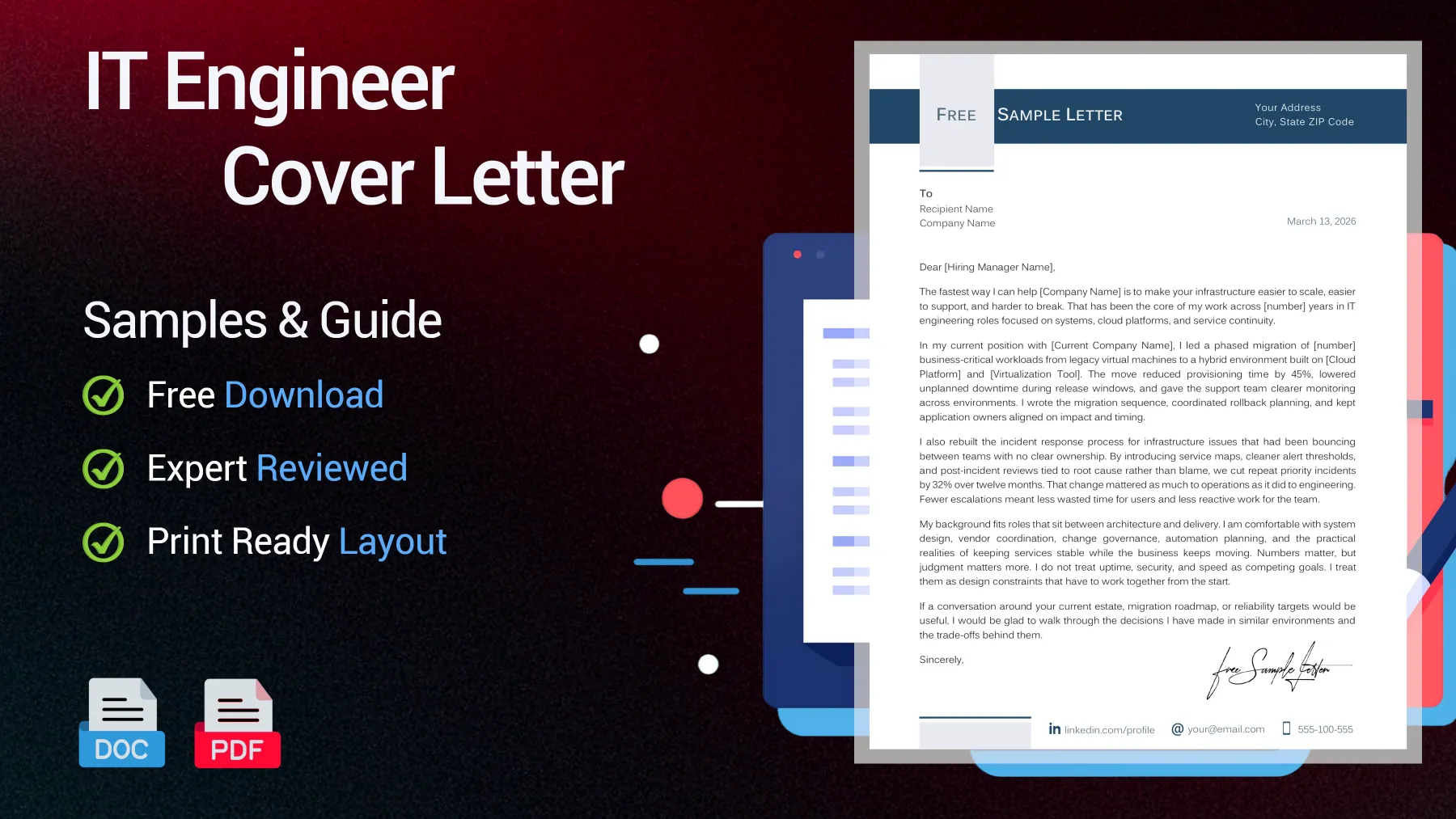
IT Architect and IT Engineer Free Samples for Applications
According to the BLS, demand for computer network architects is projected to grow 12% from 2024 to 2034. That is why a strong IT engineer cover letter should highlight your design decisions, cloud migration results, and system reliability contributions.
Junior Information Technology Engineer Application Letter
Suited to a junior candidate with no long work history, this IT engineer application letter shows how to sound capable through process, lab evidence, and clean technical judgment.
Dear [Hiring Manager Name],
Reliable systems are built long before anyone notices them. That's what attracted me to the IT engineer role at [Company Name]: the opportunity to support infrastructure that needs to run quietly, consistently, and under real-world pressure.
During my final year at [University Name], I led the infrastructure portion of a team project migrating a small internal application from a single on-premises server to a virtualized lab environment. I mapped dependencies, documented the build, and created a rollback checklist before any changes went live. This approach helped our team complete the migration without data loss and reduced deployment time from nearly two hours to under forty minutes.
I also built and maintained a home lab to develop the skills employers look for in junior engineers. In that setup, I configured Windows Server, basic Linux services, VLAN segmentation, user permissions, backup routines, and monitoring with [Tool Name]. When a misconfigured policy blocked access for several test accounts, I traced the issue, corrected the rules, and updated the setup notes to ensure the problem wouldn't recur during the next rebuild.
I ensure the quality of my work by testing changes in a controlled environment, writing clear documentation, and verifying the rollback path before making any important updates. That discipline matters in IT engineering because speed without caution often leads to the next support ticket.
What I offer [Company Name] is not a claim that I've seen every production scenario, but a reliable process, solid technical foundations, and the willingness to learn your environment quickly and thoughtfully.
A technical interview or a short discussion about your current infrastructure priorities would be the best next step. I'd appreciate the chance to share how I approach system reliability, support, and change control.
Sincerely,
[Your Name]

Reviewed by James R., Hiring Manager
I trust this sample because it shows method before confidence. The change-control detail feels closer to real engineering work than classroom sales talk.
Senior IT Architect / Engineer Cover Letter
Created for a senior infrastructure profile, this application letter shows architecture judgment, service continuity, and stakeholder control in a way recruiters trust.
Dear [Hiring Manager Name],
The most valuable way I can help [Company Name] is by making your infrastructure easier to scale, simpler to support, and more resilient. That's been the foundation of my work across [number] years in IT engineering roles focused on systems, cloud platforms, and service continuity.
In my current position at [Current Company Name], I led a phased migration of [number] business-critical workloads from legacy virtual machines to a hybrid environment using [Cloud Platform] and [Virtualization Tool]. This transition reduced provisioning time by 45%, lowered unplanned downtime during release windows, and provided the support team with clearer monitoring across environments. I developed the migration sequence, coordinated rollback planning, and kept application owners informed about impact and timing throughout the process.
I also redesigned the incident response process for infrastructure issues that were previously passed between teams without clear ownership. By introducing service maps, clearer alert thresholds, and post-incident reviews focused on root cause rather than blame, we cut repeat priority incidents by 32% over twelve months. This change benefited both operations and engineering: fewer escalations meant less wasted time for users and a more proactive team.
My background positions me well for roles that connect architecture and delivery. I'm experienced in system design, vendor coordination, change governance, automation planning, and the practical realities of maintaining stable services while the business continues to evolve.
Metrics matter, but judgment matters more. I don't treat uptime, security, and speed as competing goals. They are design constraints that must work together from the outset.
If a conversation about your current environment, migration roadmap, or reliability targets would be helpful, I'd be glad to walk through the decisions I've made in similar situations and the trade-offs involved.
Sincerely,
[Your Name]
Reviewed by James R., Hiring Manager
I would move this candidate forward because the letter ties architecture work to uptime, migration control, and measurable operational results.
Mid-Career Switch to IT Engineer Application Letter
Designed for a reconversion profile, this application letter connects transferable habits to IT engineering while staying honest about the shift in career path.
Dear [Hiring Manager Name],
Three months into building my home lab, I lost remote access on a Sunday night and had to rebuild the system step by step using my own documentation. That experience confirmed two things: I enjoy the precision of IT work, and I want to pursue it as my next profession, not just as a side project.
I am applying for the IT engineer role at [Company Name] as part of a deliberate career change from [Previous Industry]. In my previous work, I learned how to manage pressure, document processes, and stay accountable when others depend on the outcome. Over the last [number] months, I've redirected that discipline into technical training, certification study, and hands-on lab work focused on systems administration, networking, and user support.
In my lab, I built a small Windows and Linux environment with user accounts, group policies, shared resources, backup routines, and segmented network testing. I also prepared for [Certification Name] by working through scenarios involving permissions, patching, incident triage, and basic cloud administration in [Cloud Platform]. In one project, I diagnosed intermittent access failures between test machines, traced the issue to a faulty rule configuration, fixed it, and updated my documentation so the solution could be repeated reliably.
Changing careers has made me honest about what I know and what I still need to learn. That honesty is valuable in IT. It keeps troubleshooting grounded and prevents small technical issues from turning into larger problems.
What I offer [Company Name] isn't a recycled story about being passionate about technology. It's a well-considered decision to enter IT engineering with structure, patience, and tangible evidence of effort behind my transition.
I would welcome a conversation about how strong learning habits, technical discipline, and a proven career shift can contribute from day one.
Sincerely,
[Your Name]
Reviewed by James R., Hiring Manager
I trust this sample because the candidate explains the career change with method, logs, and troubleshooting detail instead of vague motivation.
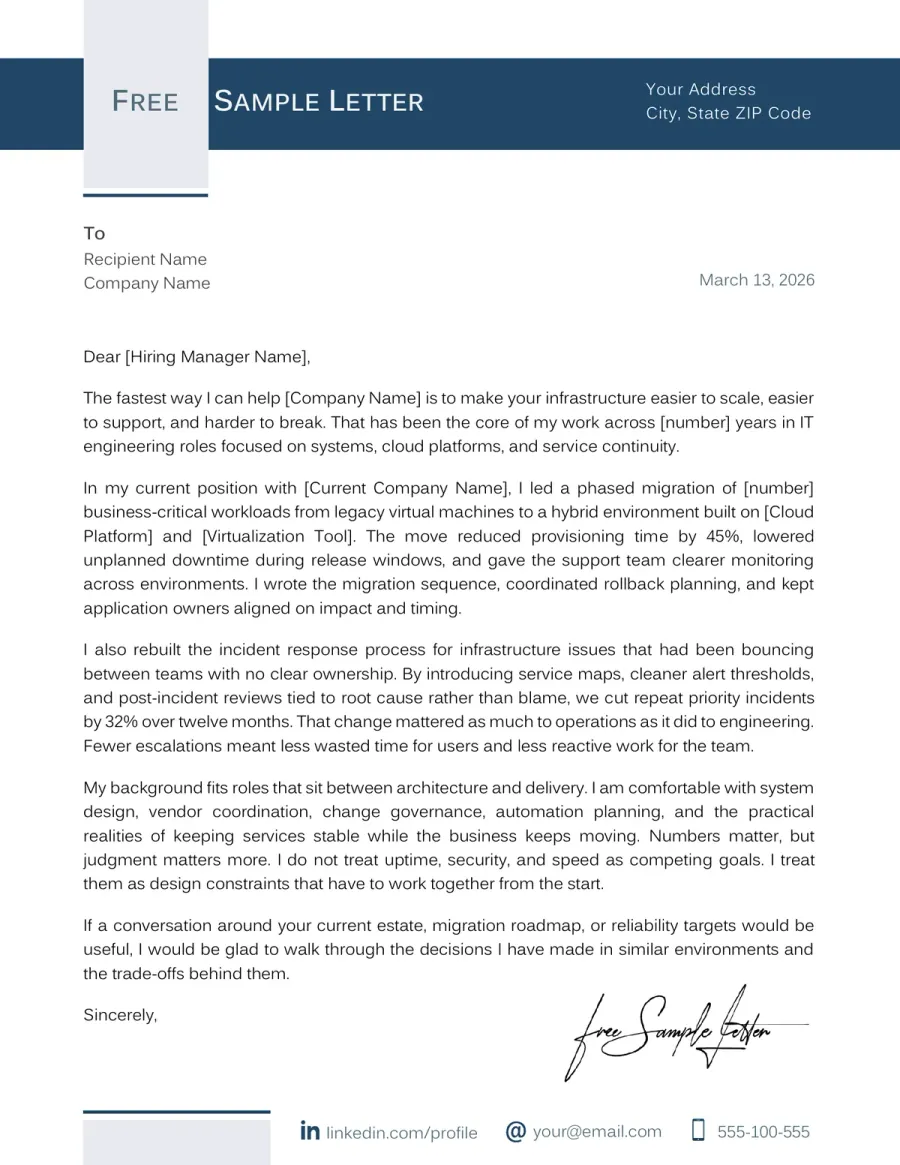
IT Engineer Template Before Word or PDF Download
Preview the IT engineer template before downloading the editable Word or PDF version. Reviewing the document beforehand helps you assess the structure, tone, and layout of your application letter before saving it.
Make These IT Engineer Cover Letter Examples Yours
Copy-pasting a generic letter rarely works in IT hiring. Recruiters quickly recognize letters that could apply to any infrastructure role. Instead, adapt these templates to fit your specific environment, the tools you use, and the types of system challenges you are prepared to address.
➡️ More expert advice in our article how to write a job-ready cover letter for technical roles
Start with the role reality
Read the job posting like an engineer, not a student. Identify the true pain points: uptime, cloud migration, support load, automation, architecture, or cross-team delivery, and build your letter around addressing those needs.
See the role focus
Instead of opening with a broad interest in technology, try: I am applying for the IT engineer role at [Company Name] because your team needs someone who can improve system reliability while supporting ongoing infrastructure changes.
Replace the generic hook
Your first lines should sound like the start of a real application letter, but they must also create relevance. Connect your background to a technical need the company is likely facing now, rather than expressing a general enthusiasm for IT.
See a stronger opening
Stable systems are rarely noticed until they fail. That is why the IT engineer role at [Company Name] caught my attention. My best work has always sat at the point where reliability, change control, and delivery meet.
Add one result recruiters can picture
Avoid listing a long string of tools. Instead, highlight one action with a clear result, such as faster provisioning, fewer repeat incidents, smoother cutovers, cleaner documentation, or stronger backup validation. Concrete results build trust.
See the proof move
I led the server migration plan for [number] internal workloads, wrote the rollback checklist, and helped cut deployment time from nearly two hours to under forty minutes without data loss.
Match your level and scope
A junior letter should convey that you are trainable and methodical. A senior letter should demonstrate accountability for decisions, trade-offs, and delivery. If you are changing careers, your cover letter must make the transition believable by providing concrete proof, not just enthusiasm.
See the level shift
If you are early in your career, focus on lab work, testing routines, and documentation. If you are more experienced, emphasize migration scope, uptime, vendor coordination, and the operational impact of your design choices.
Close with a technical next step
The closing lines should invite a practical conversation. Suggest discussing infrastructure priorities, support loads, migration plans, or system reliability. This approach feels more natural than a standard polite closing.
See the closing line
I would appreciate the opportunity to discuss your current infrastructure priorities and to share how I approach reliability, change planning, and support in settings where downtime has real consequences.
Keyword Radar for IT Engineer Letters That Get Read
- Terraform
- Incident response
- Windows Server
- Rollback-ready deployment notes
- Hybrid cloud migration planning
- Monitoring
- Root cause analysis
- Linux administration
- Identity and access management
- Cross-team communication
- Automation
- Backup validation
- Observability dashboards
- Patching and configuration baselines
Do & Don't for a Credible IT Engineer Cover Letter
Recruiters read IT engineer letters with one question in mind: does this person understand real operational work, or are they repeating keywords? Precision, judgment, and believable proof change the reading immediately.
Red Flags Hiring Teams Notice Fast
Red Flags- Stack tools with no context
- Claim architecture ownership too early
- Describe yourself instead of the work
- Use generic hooks that fit any tech role
- Hide behind buzzwords like innovative or passionate
Trust Signals That Sound Credible
Trust Signals- Anchor achievements to uptime, speed or stability
- Show change control, documentation or rollback discipline
- Match the tone to your actual level
- Connect your tools to a business need
- End with a practical discussion about the environment
FAQ - IT Engineer Cover Letter
Should I mention certifications if I do not have much production experience yet? Toggle answer
Yes, but don't present certifications as a substitute for real experience. Pair each certification with a concrete lab, project, or troubleshooting example that shows how you applied what you learned.
Can I apply for an IT engineer role if most of my background is support or admin? Toggle answer
Yes, if your letter demonstrates engineering habits such as change control, documentation, root-cause analysis, automation, or system reliability. The transition should sound like a progression in scope, not simply a title change.
How do I mention cloud migration work if I only owned one part of the project? Toggle answer
Be specific about your area of responsibility. Describe what you managed: testing, rollback documentation, cutover preparation, monitoring, permissions, or post-migration checks. Recruiters trust precise scope more than exaggerated claims.
Why does a senior IT engineer cover letter get no responses even with strong experience? Toggle answer
Because many senior-level letters read like inventory lists. Years of experience alone do not demonstrate judgment. Hiring teams want to see evidence of decisions, trade-offs, outage context, migration control, and proof you improved reliability or delivery.
Is a home lab worth mentioning for an IT engineer application? Toggle answer
Yes, especially for junior or career-change candidates. Mention your home lab only if it demonstrates something practical, like user management, backups, patching, monitoring, scripting, or a real issue you diagnosed and resolved.
TL;DR - What Makes an IT Engineer Cover Letter Worth Reading
A strong IT Engineer cover letter proves three things fast: what kind of systems you worked on, what technical problems you helped solve, and how your decisions affected reliability, delivery, or support. The fatal mistake is turning the letter into a stack of tools or a vague claim of “architecture” with no real scope behind it.
Recruiters rarely remember the longest paragraph. Instead, they recall one clear signal of judgment: a migration you managed, an outage you stabilized, a rollback you planned, or a process you improved. The best Information Technology Engineer cover letters sound operational, honest about ownership, and composed under production pressure.