
Journalist Cover Letter Examples That Editors Notice in 2026
Editors scan quickly and make decisions even faster. A vague journalist cover letter won’t make the cut. These samples show how to present your reporting value with clarity and impact.
Free Journalist Cover Letter Samples for Newsroom Roles
According to the U.S. Bureau of Labor Statistics, employment of news analysts, reporters, and journalists is projected to decline from 2024 to 2034, even though about 4,100 openings are expected each year on average. Editors receive far more applications than there are open positions. Your cover letter must immediately demonstrate relevance, not just ambition.
Junior Entry-Level Journalist Cover Letter
Built for junior entry-level journalists who need to prove reporting skill without a full-time newsroom role.
Dear [Editor’s Name],
I’m drawn to your newsroom’s commitment to local accountability reporting: clear facts, strong structure, and stories that matter to readers. That’s exactly the kind of journalism I’ve trained for.
During my final semester at [University], I covered a city council meeting where budget cuts were buried in a 200-page report. I spent two evenings breaking down the document line by line, confirmed the figures with two council members, and turned it into a 900-word article that became the most-read piece on our student platform that week. Locally, it was shared more than 1,200 times.
I work quickly, but never at the expense of accuracy. For another project, I reported an investigative feature on rental price increases, gathering testimonies from 14 tenants and cross-checking public data. That story was later referenced by a regional radio show.
Picture a looming deadline, a source calling back with new figures, and a last-minute correction needed. I double-check the numbers, update the quote, rewrite the lead, and file clean copy. No drama, just accuracy.
I’m eager to contribute to [Newsroom Name] by approaching daily reporting with discipline and consistently pitching fresh story angles from the field. I’d welcome the opportunity to discuss how I can support your editorial team.
Sincerely,
[Your Name]
Reviewed by Nina P., Senior Editor
I like how the candidate shows initiative with real reporting examples. It feels concrete, not theoretical.
Senior Journalist Cover Letter
Designed for senior reporters with 5–15+ years in media who must prove audience growth, investigative depth, and editorial leadership.
Dear [Editor-in-Chief’s Name],
Your investigative desk is recognized for long-form pieces that help shape public debate. Achieving this kind of impact requires both precision and persistence.
Over the past eight years at [Previous Publication], I’ve published more than 220 articles, including a three-part investigative series on procurement fraud that led to an internal audit at a regional agency. That series attracted 85,000 unique views in its first week and was shortlisted for a national press award.
I also led a small reporting team covering economic policy. After restructuring our pitch meetings and introducing formal fact-checking checkpoints, we reduced post-publication corrections by 40% over two years.
I can support [Publication Name] by strengthening your investigative efforts and mentoring junior reporters in structured sourcing and document analysis.
If this aligns with your editorial goals for 2026, I’d appreciate the chance to discuss how my reporting approach could support your future projects.
Respectfully,
[Your Name]
Reviewed by Nina P., Senior Editor
The leadership example reassures me about newsroom maturity. Strong positioning.
Journalism Internship Cover Letter
Built for journalism students applying for internships with limited professional clips but strong academic reporting.
Dear [Editor’s Name],
Your publication’s investigative tone is exactly the environment where I want to learn the craft of reporting.
During my second year at [University], I covered a campus protest as it unfolded. I conducted interviews on site, confirmed details with university officials, and filed a structured article within three hours. That piece became one of the most widely read student stories that month.
I’m still building my portfolio, but I already approach assignments with newsroom discipline. I outline before writing, record interviews with consent, and fact-check all quotes before submission. One professor required three source confirmations per story, a habit that has stayed with me.
Suppose a reporter needs background research before an afternoon interview. I can compile timelines, verify data points, and prepare briefing notes within a few hours.
If given the opportunity at [Publication Name], I’m ready to support your team while learning directly from experienced editors. I’d welcome a brief conversation about how I can contribute this summer.
Kind regards,
[Your Name]
Reviewed by Nina P., Senior Editor
I see readiness to learn and real field exposure. That’s rare in interns.
Journalist Cover Letter Template Preview Before Download
Below is a live preview of the journalist cover letter template. You can access an editable Word version or download a ready-to-use PDF.
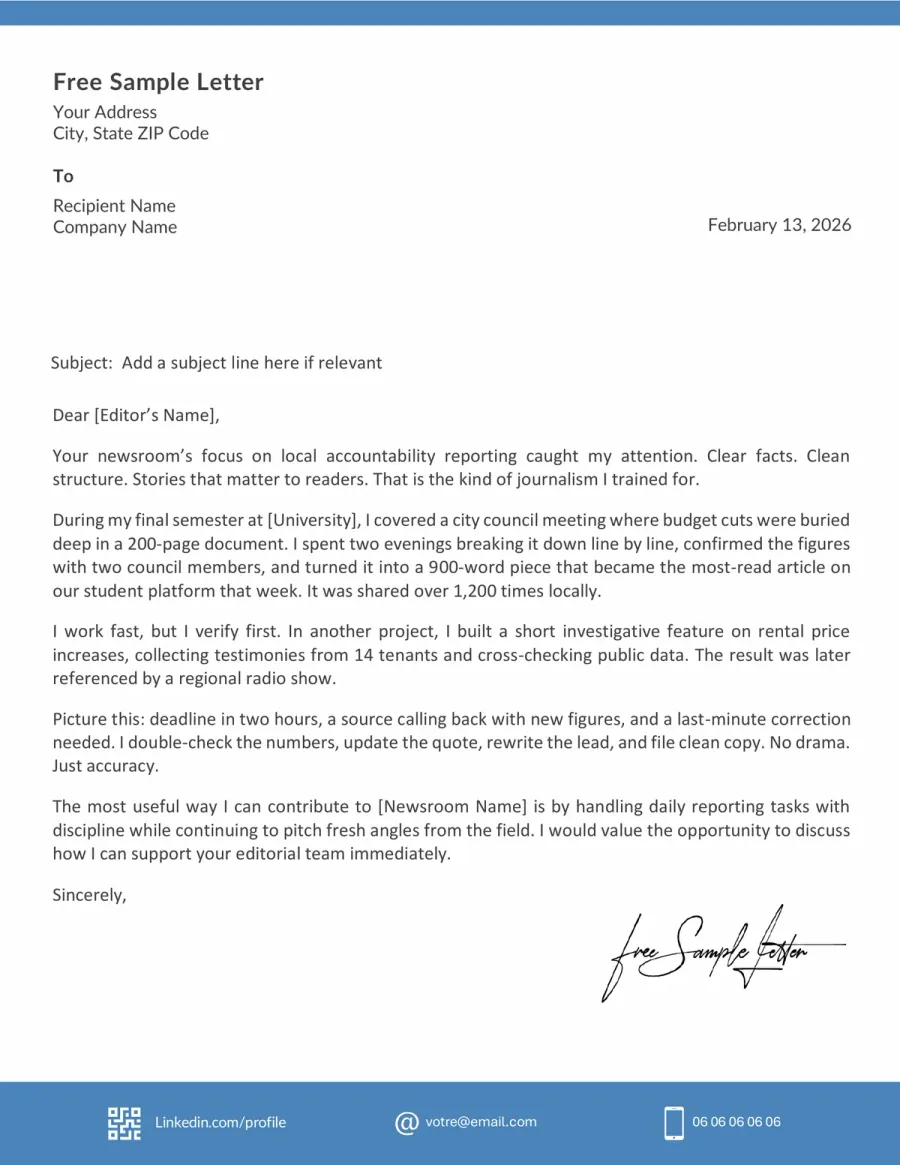
Adapt the Journalist Template to Your Editorial Voice
Copy-paste language undermines credibility in journalism. Editors spot generic phrasing immediately. Use this template as a framework, not a script. Replace every placeholder with your own reporting voice, story angles, and concrete proof points.
➡️ More expert advice in our article How to Write a Cover Letter
Research the Publication First
Before you write a single sentence, study the publication’s tone, typical story length, and editorial priorities. A political newsroom reads differently from a lifestyle blog.
See an example
“Your recent investigation on municipal contracts reflects the type of accountability reporting I have been preparing for.”
Replace Generic Claims With Proof
Remove every vague statement, such as “strong writer” or “detail-oriented.” Instead, provide a specific reporting action, tool you used, or measurable outcome.
See a rewrite
Instead of “I am organized,” write: “I managed three concurrent assignments and filed clean copy within 24-hour deadlines.”
Align Your Angle With the Role
A breaking-news reporter should highlight speed and verification, while a feature journalist should emphasize narrative depth. Tailor your letter to reflect the specific needs of the newsroom and the role.
See positioning
“I thrive under tight deadlines and confirm details through two independent sources before filing.”
Show the Newsroom in Action
Briefly describe a situation where you worked on a tight deadline. Keep it concise, but make it concrete.
See how to visualize it
“While covering a live protest, I confirmed facts on-site before publishing.”
Close With a Clear Contribution
Avoid passive endings. Clearly state how you can contribute to the newsroom right away, not just in the future.
See a strong closing
“The fastest way I can support your desk is by handling daily briefs while pitching local investigative leads.”
What Editors Scan Instantly
- Investigative reporting
- Deadline-driven newsroom
- AP Style
- Source verification process
- Breaking news
- Audience growth metrics
- Data journalism tools (Excel, Tableau)
- Interview transcription accuracy
- Feature storytelling
- Fact-check workflow before publication
- Bylines
- CMS publishing systems
- Cross-checking public records under time pressure
- Media law basics
- Live coverage
Do & Don’t - What Makes an Editor Keep Reading or Stop Immediately
Editors read quickly and look for clarity, relevance, and evidence. A journalist cover letter is judged like an article lead: a weak opening, vague claims, or poor structure leads to rejection. Strong proof and newsroom awareness help your letter make the cut.
Red Signals That Kill Credibility
Red Flags- Describe yourself instead of your reporting
- Mention passion without showing proof
- Ignore the publication’s editorial focus
- Submit long blocks of text with no structure
- Sound like you are applying to every newsroom
Signals That Build Editorial Trust
Trust Signals- Open with a reference to a recent article or series
- Show at least one measurable reporting result
- Mention tools or workflows used in real journalism
- Demonstrate understanding of deadlines and verification
- Propose a concrete way you can support the desk
FAQ - Journalist Cover Letter
Should I pitch story ideas in my journalist cover letter? Toggle answer
Yes, as long as your ideas are specific and realistic. Two short, focused pitches are better than ten vague ones. Show the angle, likely sources, and why that newsroom should care. This demonstrates that you understand their audience and can think within editorial constraints.
I don’t have major bylines yet. What do I put instead? Toggle answer
Lead with your strongest evidence of reporting behavior: interviews, document work, data pulls, corrections you prevented, or a story you advanced through persistence. If you have subject expertise, explain “why I’m the right person to report this” rather than providing a biography.
How do I prove I can fact-check, not just write well? Toggle answer
Describe your verification habits. For example: confirming key claims with two sources, reading back quotes when appropriate, and doing a final check for numbers, names, and titles. Editors trust a clear process. “I’m detail-oriented” is generic; explaining your verification routine is credible.
How do I make my clips matter if the editor doesn’t know my beat? Toggle answer
Provide one line of context for each clip: what you uncovered, how you achieved it, and the impact, such as readership, follow-up, or official response. Don’t summarize the entire piece. Show the editor why that clip demonstrates your readiness for the newsroom.
What if the portal doesn’t ask for a cover letter at all? Toggle answer
Don’t force it. Follow instructions exactly. If there’s an “Additional info” box, use it for a concise 5–7 sentence mini-letter: show role fit, provide two pieces of evidence, add one tailored angle, and include a clear next step. If there’s nowhere to upload a letter, simply skip it.
TL;DR - Your 5-Minute Action Plan to Stand Out as a Journalist
If you want your journalist cover letter to work, focus on three things: show real reporting behavior, prove your verification habits, and connect your experience to the publication’s editorial needs. Mention clips, sources, deadlines, data work, or audience results when relevant. Avoid vague claims about passion or writing ability. Editors need proof that you can report, verify, write cleanly, and contribute quickly.
Now take five minutes. Open your draft. Add one concrete reporting example. Insert one detail about your verification process. Remove one generic sentence. That small edit can make your application feel much closer to a real newsroom fit.