
Graphic Designer Cover Letter Examples You Can Actually Use in 2026
Even if your work is visually strong, your cover letter must clearly explain your design choices. These samples show how to connect creativity, software skills, and business value in a way that sounds specific and relevant, not generic.
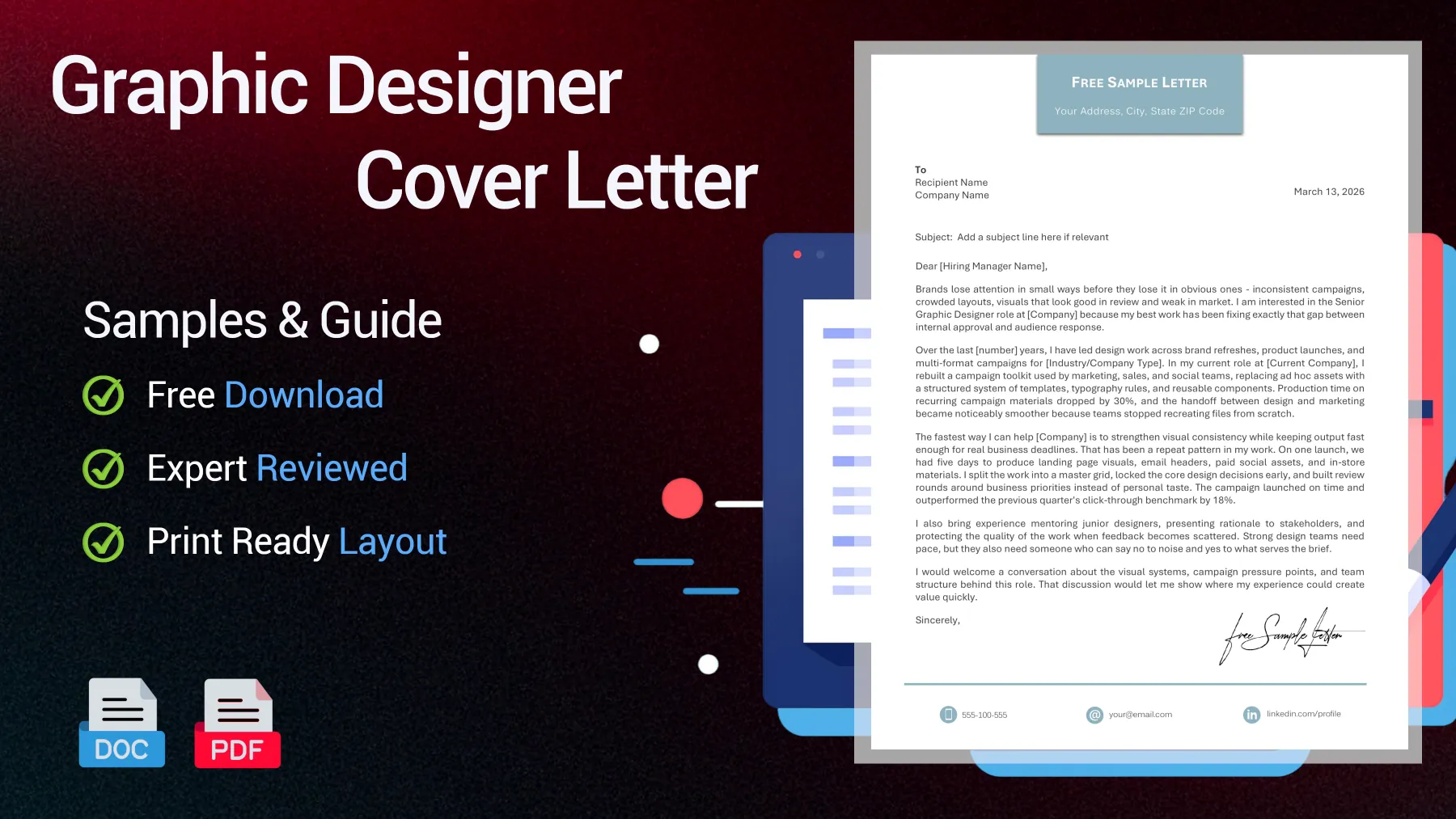
Free Graphic Designer Cover Letter Samples for a Job Application
According to the BLS, companies’ digital presence may sustain demand for graphic designers, even as AI tools reduce some freelance opportunities. Expert advice: your letter should demonstrate judgment, brand thinking, and collaboration, not just technical skills.
Graphic Designer Cover Letter for a Junior Art School Graduate
Made for a junior art school graduate, this graphic designer cover letter turns portfolio pieces into proof. It helps an entry-level candidate sound credible without faking experience.
Dear [Hiring Manager Name],
Good design solves problems even before style enters the conversation. That’s what drew me to the Graphic Designer opening at [Company]. Your team needs someone who can turn ideas into visuals that people grasp quickly. That’s the work I trained for at [School Name], where every project required defending our decisions, not just making things look polished.
In my final branding project, a local coffee shop owner told us her packaging looked handmade in the wrong way: busy, unclear, and hard to read on a shelf. I rebuilt the label system in [Adobe Illustrator] and [InDesign], reduced the type hierarchy to three levels, and created color rules that worked across cups, menus, and takeaway cards. During critique, the mock-up was among the few student projects selected for public display because the concept stayed consistent from print to point of sale.
My portfolio also includes social media assets, poster layouts, and editorial spreads developed under tight review deadlines. For one project, I had just two days from concept board to final export. I organized the file structure up front, kept feedback notes beside each version, and avoided last-minute redesign spirals. That habit matters to me: a designer shouldn’t make the team guess where the final files are or why a layout changed.
One moment stays with me: at 11 p.m. in the studio, a poster still felt wrong. I stepped back, removed two decorative elements, widened the margins, and finally the message landed. That taught me as much about restraint as creativity.
I’d welcome the chance to walk you through two portfolio pieces that show how I think, revise, and deliver. If helpful, I can also bring the source files to discuss typography, grid decisions, and production choices.
Sincerely,
[Your Name]

Reviewed by James R., Hiring Manager
I notice the letter never hides the lack of experience. It replaces it with concrete studio evidence, which makes the junior profile easier to trust.
Senior Graphic Designer Cover Letter for Brand and Campaign Work
Created for an experienced senior graphic designer, this application letter focuses on brand consistency, measurable outcomes, and cross-team delivery. It helps a seasoned candidate show leadership.
Dear [Hiring Manager Name],
Brands lose attention in subtle ways long before it’s obvious: inconsistent campaigns, crowded layouts, and visuals that look good in review but fall flat in the market. I’m interested in the Senior Graphic Designer role at [Company] because my best work has been bridging that gap between internal approval and audience response.
Over the last [number] years, I’ve led design projects across brand refreshes, product launches, and multi-format campaigns for [Industry/Company Type]. In my current role at [Current Company], I rebuilt a campaign toolkit for marketing, sales, and social teams, replacing ad hoc assets with a structured system of templates, typography rules, and reusable components. Production time on recurring campaign materials dropped by 30%, and the handoff between design and marketing became noticeably smoother because teams stopped recreating files from scratch.
The most immediate way I can help [Company] is by strengthening visual consistency while keeping delivery fast enough for business deadlines. That’s a repeat pattern in my work. On one launch, we had just five days to produce landing page visuals, email headers, paid social assets, and in-store materials. I divided the work using a master grid, locked in core design decisions early, and built review rounds around business priorities, not personal taste. The campaign launched on time and outperformed the previous quarter’s click-through benchmark by 18%.
I also have experience mentoring junior designers, presenting rationale to stakeholders, and protecting quality when feedback is scattered. Strong design teams need pace, but they also need someone willing to say no to noise and yes to what serves the brief.
I’d welcome a conversation about the visual systems, campaign pressure points, and team structure behind this role. That discussion would let me show where my experience could add value quickly.
Sincerely,
[Your Name]
Reviewed by James R., Hiring Manager
The numbers help, but what convinces me most is the operational thinking behind the design work. That is what senior hires should bring.
Graphic Designer Internship Cover Letter for a Design Student
Tailored to a student profile, this graphic designer internship letter highlights learning speed, visual judgment, and studio discipline. It helps a future intern connect coursework to a real team.
Dear [Hiring Manager Name],
An internship matters when it puts a student close to real feedback, real revisions, and real deadlines. That’s why I’m applying for the Graphic Designer Internship at [Company]. I want to learn inside a team where ideas are tested against business needs, not just classroom critique.
I’m currently studying at [School Name], where I’ve worked on branding exercises, poster systems, and digital layouts using [Adobe Photoshop], [Illustrator], and [InDesign]. In a recent assignment, I built a campaign for a small cultural event and adapted the concept into a poster, Instagram sequence, and email banner. That project taught me how easily a design can lose impact when the hierarchy shifts between formats, so I started planning reusable visual rules before moving into polished mock-ups.
One studio session changed the way I work. A tutor stopped at my desk, looked at a layout for ten seconds, and asked, “What do you want people to notice first?” I didn’t have a good answer. Since then, I start every project by defining the main message, audience, and visual priority before jumping into tools.
I’m not applying as someone who already knows every production reality of a professional studio. I’m applying as someone who learns quickly, takes feedback seriously, and enjoys the part of design that happens after the first idea. I keep organized files, label versions clearly, and like understanding why one solution works better than another.
I’d be glad to discuss how I could support your team on day-to-day design tasks while learning from your process. If helpful, I can bring portfolio samples to show how I develop a concept from rough sketch to final layout.
Best regards,
[Your Name]
Reviewed by James R., Hiring Manager
I would keep this application in the interview pile because it shows teachability, visual thinking, and enough discipline for a busy team.
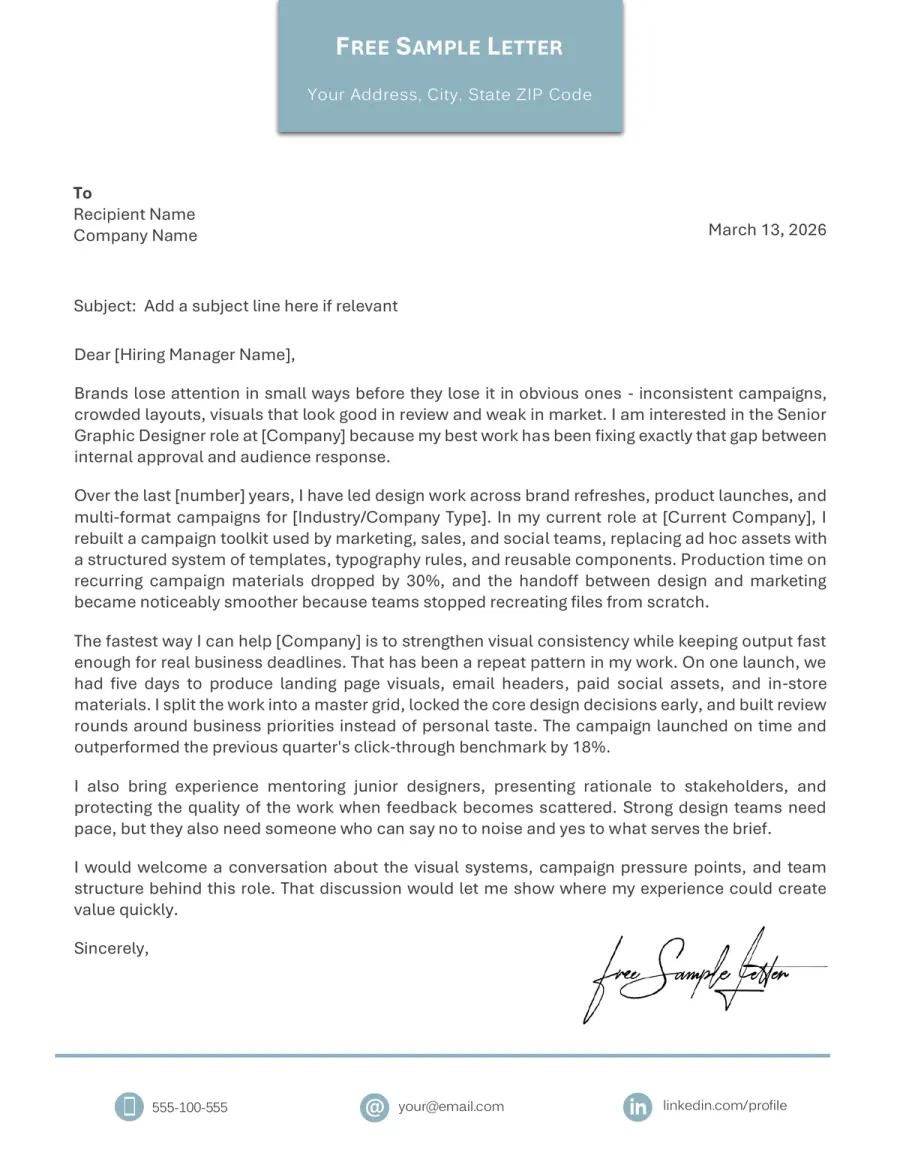
Graphic Designer Cover Letter Template Preview Before Word / PDF Download
Preview the graphic designer cover letter template before downloading the editable files. Choose the Word or PDF version that best fits your application process.
Make These Graphic Designer Cover Letter Samples Yours
A copy-paste letter often falls flat because it overlooks your portfolio, your skill set, and the specific role. Adapt each sample to the company, the design challenges they face, and the type of visual work they produce.
➡️ Want better wording and structure? See how to write a cover letter that fits the role and the company
Match the role before the wording
Start with the job post, not just the sample. Identify the specific design tasks, tools, and channels mentioned, and keep only the parts of the template that directly support those needs.
See an example
Instead of keeping a generic opening, write: I am drawn to this role because it combines brand consistency, social assets, and quick-turn campaign work, which matches the strongest pieces in my portfolio.
Replace vague claims with portfolio proof
Avoid saying you are creative, detail-oriented, or passionate. Instead, highlight one or two projects that show how you solved a layout, branding, packaging, or multi-format communication challenge.
See an example
In my final branding project, I rebuilt the visual system for [project name], simplifying the typography and color rules so the concept worked across posters, social posts, and printed materials.
Name the tools only when they matter
Adobe Illustrator, Photoshop, InDesign, and Figma are useful keywords, but mention them only when they support a specific task or explain your process, not as a disconnected software list.
See an example
I built the editorial layout in InDesign, refined image balance in Photoshop, and prepared final exports with a file structure that made revisions easier for the team.
Adjust the tone to the company
A design studio, fashion brand, and software company will each respond to a different voice. Match your tone to the employer’s visual identity, pace, and audience.
See an example
For a modern brand, a tighter line works: I like design that earns attention through clarity, not noise. For a more formal employer, use a steadier voice focused on consistency and delivery.
End with a design-specific next step
Avoid a generic closing. End by inviting a conversation about your portfolio, source files, campaign work, or design process so your last line stays relevant to the role.
See an example
A better finish is: I would value the chance to walk you through two portfolio pieces and explain the layout, typography, and revision choices behind them.
Graphic Designer Keyword Radar for Recruiters and ATS
- Adobe Creative Suite
- Brand guidelines
- Typography
- Social media assets
- Figma
- Print-ready files
- Cross-functional work with marketing teams
- Layout systems
- Campaign visuals
- Portfolio
- Presentation design
- Adapt concepts into multiple formats
- File organization
- Brand consistency across campaigns
- Photoshop
- Creative feedback
- InDesign
Do & Don't for a Graphic Designer Cover Letter That Feels Credible
Recruiters scan designer letters for judgment, not decoration. They want to see how you think, what you’ve created, and whether your portfolio, tone, and examples match the work on their desk.
Red Flags Recruiters Notice Fast
Red Flags- Open with generic excitement and no link to the role
- Repeat portfolio, creative, or passion without proof
- List software with no project context
- Ignore the company’s brand world and audience
- Use a closing that could fit any job on the page
Trust Signals That Make the Letter Stronger
Trust Signals- Lead with a real design need you can address
- Anchor the letter in one or two portfolio examples
- Show how tools supported a deliverable or workflow
- Write in a tone that matches the employer’s visual culture
- Close by inviting a portfolio or process-based discussion
FAQ - Graphic Designer Cover Letter
Do I still need a cover letter if my portfolio is strong? Toggle answer
Yes, especially when the employer requests one or when your fit isn’t immediately clear. The portfolio shows your work. The letter explains why your projects, style, and workflow connect with that particular role.
Should I place my portfolio link inside the cover letter? Toggle answer
Yes. Keep it visible and easy to find. In design hiring, a buried or missing portfolio link makes your application harder to review, even if your work is strong.
How creative should a graphic designer cover letter actually look? Toggle answer
Prioritize clarity over cleverness. A touch of personality helps, but readability always comes first. If the layout feels gimmicky or the message gets lost, your design choices may work against you.
I only have school projects. What should I talk about instead of experience? Toggle answer
Use school, freelance, or internship projects if they show your decision-making process. Details like the brief, audience, tools, revisions, and final outcome matter more than pretending you have agency-level experience.
Should I change the tone for an agency and an in-house brand team? Toggle answer
Yes. Agency letters should show pace, range, and adaptability, while in-house letters should emphasize consistency, collaboration, and long-term brand stewardship. The same portfolio can be presented differently for each context.
TL;DR - A Graphic Designer Cover Letter Has to Frame the Portfolio
A strong graphic designer cover letter doesn’t compete with the portfolio. It frames it. Highlight one or two real projects, explain the design decisions behind them, and mention tools only when they directly support a deliverable. The biggest mistake is sending a polished letter that says nothing concrete.
Recruiters often look for judgment between the lines. They want to see if you can prioritize what matters, keep your message clear, and adapt your tone to the team you’re applying to. In a graphic design cover letter, restraint often feels more credible than forced creativity.