
Tour Guide Cover Letter Examples You Can Adapt for 2026
Hiring managers don’t want another letter about a passion for travel. This page shows you how to highlight public speaking, itinerary management, multilingual skills, and real-time judgment with stronger impact.
Free Tour Guide Cover Letter Samples for Your Application
The U.S. Bureau of Labor Statistics projects 8% growth for tour and travel guides from 2024 to 2034. Expert interpretation: your letter should prove group pacing, visitor engagement, and calm adjustments when plans shift.
Tour Guide Cover Letter for a Junior Bilingual Candidate
Built for a junior bilingual candidate, this tour guide cover letter leans on language fluency, public contact, and local knowledge instead of invented experience.
Dear [Hiring Manager Name],
A good city tour depends on two things visitors notice immediately: clear explanations and a guide who can adjust smoothly to people, questions, and timing. That’s exactly the kind of role I hope to take on with [Company Name].
I’m currently gaining experience through [degree / studies / volunteer work], where I regularly speak with people from different backgrounds in both [Language 1] and [Language 2]. At a recent student welcome event, I helped lead small groups of international visitors around campus, answered practical questions on the move, and adjusted the route when one stop became unavailable. The change was minor, but it taught me something important: a group stays engaged when the guide is calm, informed, and easy to follow.
Outside class, I’ve spent real time learning the stories, landmarks, and local customs that shape [City / Region]. I keep notes on routes, travel times, crowd patterns, and short facts that are easy to share on the move. During a volunteer event for [organization], I supported guests unfamiliar with the area, gave directions, and managed last-minute schedule changes without letting confusion reach the group. These moments may not be formal tour guiding on paper, but they use the same core habits: reading a group, explaining clearly, and helping people feel comfortable.
One moment stands out. A visitor asked for an explanation in [Language 2] after missing part of an introduction, while the group had already started moving. I gave a shorter version without slowing the pace, then rejoined the full group at the next stop. Small adjustments like that build trust.
I’d welcome the chance to discuss how I can support [Company Name] during [season / period] and help deliver tours that are organized, lively, and easy to follow from start to finish.
Sincerely,
[Your Name]

Reviewed by Claire M., Career Coach
I notice the bilingual angle immediately. It turns a junior profile into a usable front-line candidate instead of another vague travel application.
Experienced Travel Guide Application Letter
Built around an experienced profile, this application letter shows how to present long-term guiding work, multilingual contact, and problem-solving without drifting into autobiography.
Dear [Hiring Manager Name],
Many guides know the facts. Fewer know how to keep a group together when the day doesn’t go as planned. That’s the part of the job I’ve focused on in my [number] years in guided travel.
I’ve led historical, cultural, and scenic tours for [Company Name / agency / operator], working with domestic visitors, international groups, school parties, and private bookings. No matter the format, my priorities stay the same: keep the pace, read the audience early, and make every stop count. Last peak season, I managed up to [number] tours a week, maintained strong guest feedback, and earned repeat bookings from partner agencies who valued a guide who could handle both content and flow.
I ensure quality by always checking three things before each tour: route timing, spots where the group might lose focus, and the fastest way to recover if transport or weather disrupts the plan. This habit has helped me make good decisions in real time. During one tour in [location], a road closure forced a last-minute change less than an hour before departure. I quickly rebuilt the sequence, adjusted the narrative links between stops, and briefed the group before any confusion could set in. The tour still finished on time, and several guests later said it felt seamless.
Experience has also taught me what not to do. People don’t want a lecture. They need a guide who knows when to expand, when to keep it short, and when to let the place speak for itself. That balance matters as much as knowledge or language skills.
I’d be glad to discuss how I could bring this level of operational judgment and visitor care to [Company Name], especially for tours where consistency matters as much as personality.
Best regards,
[Your Name]
Reviewed by Claire M., Career Coach
I keep this application in the serious pile because it shows operational foresight, not just years served or generic confidence about guiding.
Career Change Tour Guide Cover Letter for a Mid-Career Applicant
Made for a mid-career changer, this tour guide cover letter explains the professional switch directly and ties past work habits to visitor-facing reality.
Dear [Hiring Manager Name],
Changing careers at this stage wasn’t a quick decision. After [number] years in operations for [former industry], I decided to move into guiding because what I valued most was always the same: helping people understand where they are, what’s next, and why the details matter.
My background isn’t in tourism, and I want to be direct about that. It’s in planning, coordination, and communication under pressure. At [Former Company], I managed schedules, handled client issues, and kept everything on track when delays hit. On one project, I had to reorganize a multi-stop field visit for partners after two appointments changed at short notice. I rebuilt the sequence, kept everyone informed, and made sure the day stayed on track without passing stress to the group.
Outside work, I’ve spent the past [number] months building practical experience in [City / Region]. I joined local history walks, studied routes, and volunteered at [museum / cultural association / event], where I welcomed visitors, answered questions, and helped people move comfortably through unfamiliar spaces. One afternoon, a couple who arrived late looked lost near the entrance. I walked them through the key points they missed, gave a brief but clear explanation, and got them back into the flow of the visit in minutes. That moment confirmed this is the work I want to do.
I bring maturity, structure, and a calm public presence to [Company Name]. I prepare carefully, listen well, and adapt without drama when conditions change. This is a real career shift for me, and I’m making it with clear intent.
I’d appreciate the chance to discuss where an organized, people-focused new guide could support your team, especially on tours that need reliability as much as local knowledge.
Sincerely,
[Your Name]
Reviewed by Claire M., Career Coach
I like that the career-change story is honest. It does not hide the switch, and it explains why guest-facing strengths now fit guiding work.
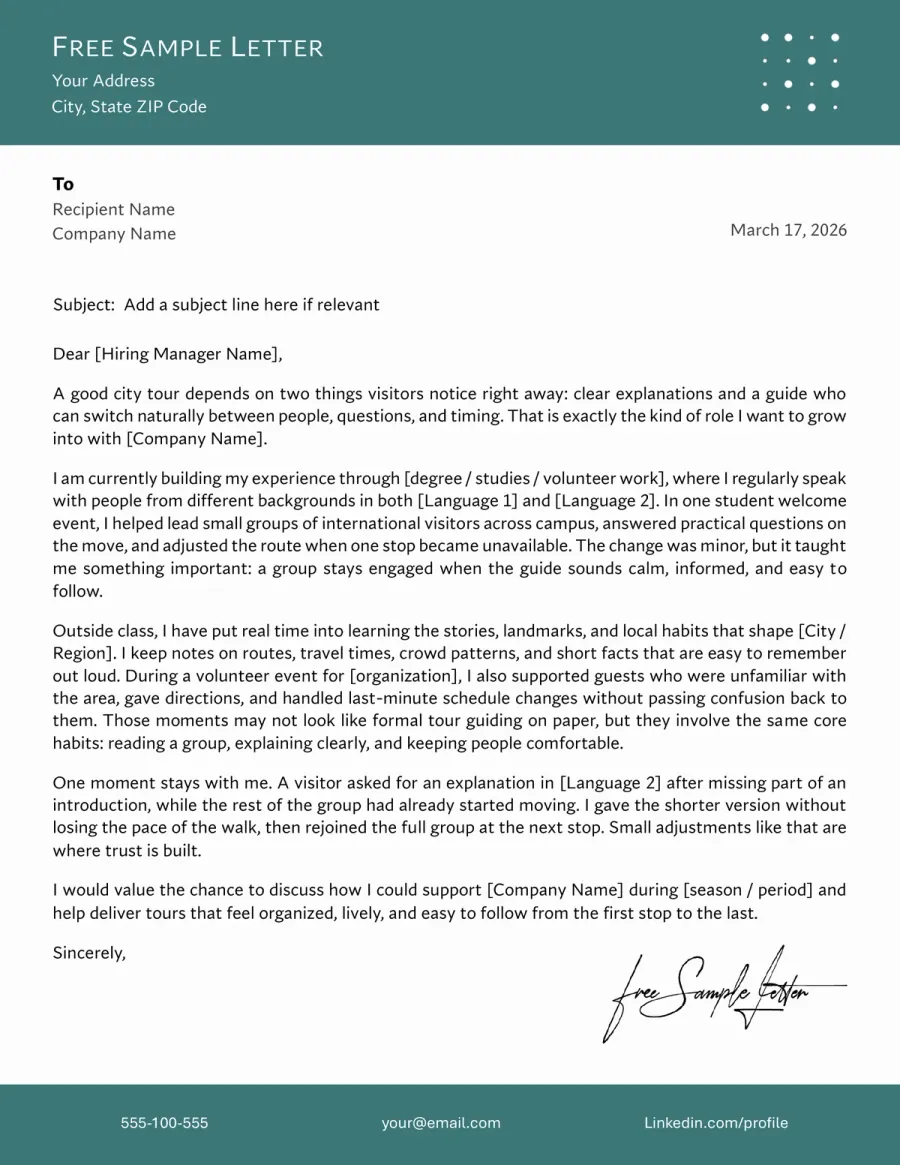
Preview the Tour Guide Cover Letter Template Before Download
Preview this tour guide cover letter template before downloading. The file is available in Word and PDF formats to streamline your application process.
Make These Tour Guide Samples Yours
Copy-pasting a tour guide cover letter rarely works because the details often feel borrowed. Instead, tailor the route details, audience, language skills, and the specific guest challenges you’re prepared to handle.
➡️ More expert advice in our article how to write a cover letter that sounds real and gets interviews
Set the Right Tour Context
Start by naming the exact tour context. City walks, coach tours, museum visits, and seasonal excursions each require a different approach, so your opening lines should reflect the specific setting.
See Open the sample detail
Instead of “I love travel,” try: “My experience guiding visitors in [City] means I’m comfortable explaining landmarks while keeping the group on pace.”
Add One Real Scene
The best proof isn’t just “people skills”. It’s a real moment when you explained something clearly, managed a small group, solved confusion, or kept an itinerary on track.
See Check the wording
“When two guests arrived late, I shortened my introduction, smoothly brought them back into the tour, and kept everyone else on schedule.”
Tune the Tone to the Employer
Match your tone to the employer. A local heritage operator may appreciate warmth and storytelling, while a large tour company often values structure, timing, and reliability.
See a tone shift
“I enjoy sharing local history” could become: “I present historical context in a way that’s clear for mixed-age groups and keeps the visit moving.”
Rewrite the Closing for the Job
Make sure your closing fits the real work of the role. Tour guiding is live and practical, so your last lines should offer help on the ground, not just a formal send-off.
See the closing
“I’d welcome the chance to discuss how I can support your summer tours and help visitors feel informed, welcomed, and well guided from start to finish.”
Read It Out Loud Before Sending
Read your full letter out loud before sending. With tour guide applications, your voice and delivery matter as much as the content. Cut anything that sounds stiff, inflated, or repetitive.
See Open a final check
If a sentence sounds like a brochure, cut it. For example, “I am deeply passionate about unforgettable experiences” is less effective than one sharp, believable work example.
Tour Guide Keyword Radar Recruiters Notice Fast
- Route pacing
- Multilingual support
- Live visitor questions
- Historical commentary
- Weather changes mid-tour
- Public speaking
- Landmark storytelling
- Local history
- Guest safety
- Mobility-aware assistance
- Adjust explanations to the group’s needs
Do & Don’t for a Tour Guide Cover Letter
Tour guide letters are read quickly. Recruiters look for evidence that you can manage a group, explain clearly, adapt on the go, and stay helpful when timing, weather, or guest questions change the shape of the visit.
Red Flags That Make the Letter Sound Unready
Red Flags- Sound like a travel fan instead of a guide
- List soft skills without one real work scene
- Ignore timing, route flow, or group management
- Use generic customer service language only
- Overload the letter with local facts and no job fit
Trust Signals That Make the Letter Feel Credible
Trust Signals- Show how you keep a group engaged and moving
- Name a real tour context or visitor setting
- Mention bilingual or multilingual use if it is real
- Prove you can adapt when plans change
- Close with a practical next step tied to the role
FAQ - Tour Guide Cover Letter
Can I apply for a tour guide job if I only have volunteer or campus guide experience? Toggle answer
Yes. Replace “no experience” wording with one real scene: welcoming groups, explaining a route, answering visitor questions, or keeping timing under control during an event.
Is being bilingual enough, or do I need to prove local knowledge too? Toggle answer
Languages help, but they do not replace route control, commentary, or guest handling. Add one line that proves you can explain places clearly while keeping people oriented on the move.
Should I mention first-aid or safety training in a tour guide cover letter? Toggle answer
Yes, when it is real and relevant. First-aid, CPR, wilderness safety, or crowd-facing training can strengthen a tour guide application because it signals calm judgment under pressure.
Do I need to address licensing or certification in the letter? Toggle answer
Only when the location, employer, or tour type expects it. If rules vary, do not bluff. A short line about current certification, pending training, or compliance awareness is enough.
How do I show I can handle live questions and keep the group moving? Toggle answer
Add one small work moment. A line about answering a late guest, adapting after weather changes, or keeping a mixed group on schedule says more than “great people skills.”
TL;DR - A Tour Guide Cover Letter Wins on Control, Not Travel Passion
A strong tour guide cover letter proves three things fast: you can speak to people clearly, keep a group moving, and stay useful when timing shifts. The fatal mistake is writing like a traveler who loves discovery instead of a guide who can lead, explain, and adapt in real time.
The deeper signal is judgment. Recruiters notice small signs of field maturity: one credible line about route pacing, one real example of handling a question live, one honest mention of language use or safety training. In a good travel guide application letter, restraint often sounds more convincing than enthusiasm.