
Combination Resume Template for Skills and Work Experience
This combination resume template helps you present your transferable skills and relevant work history in a clear, balanced, and credible way. It is designed for candidates who need a professional resume or CV layout that gives real weight to both qualifications and employment chronology.
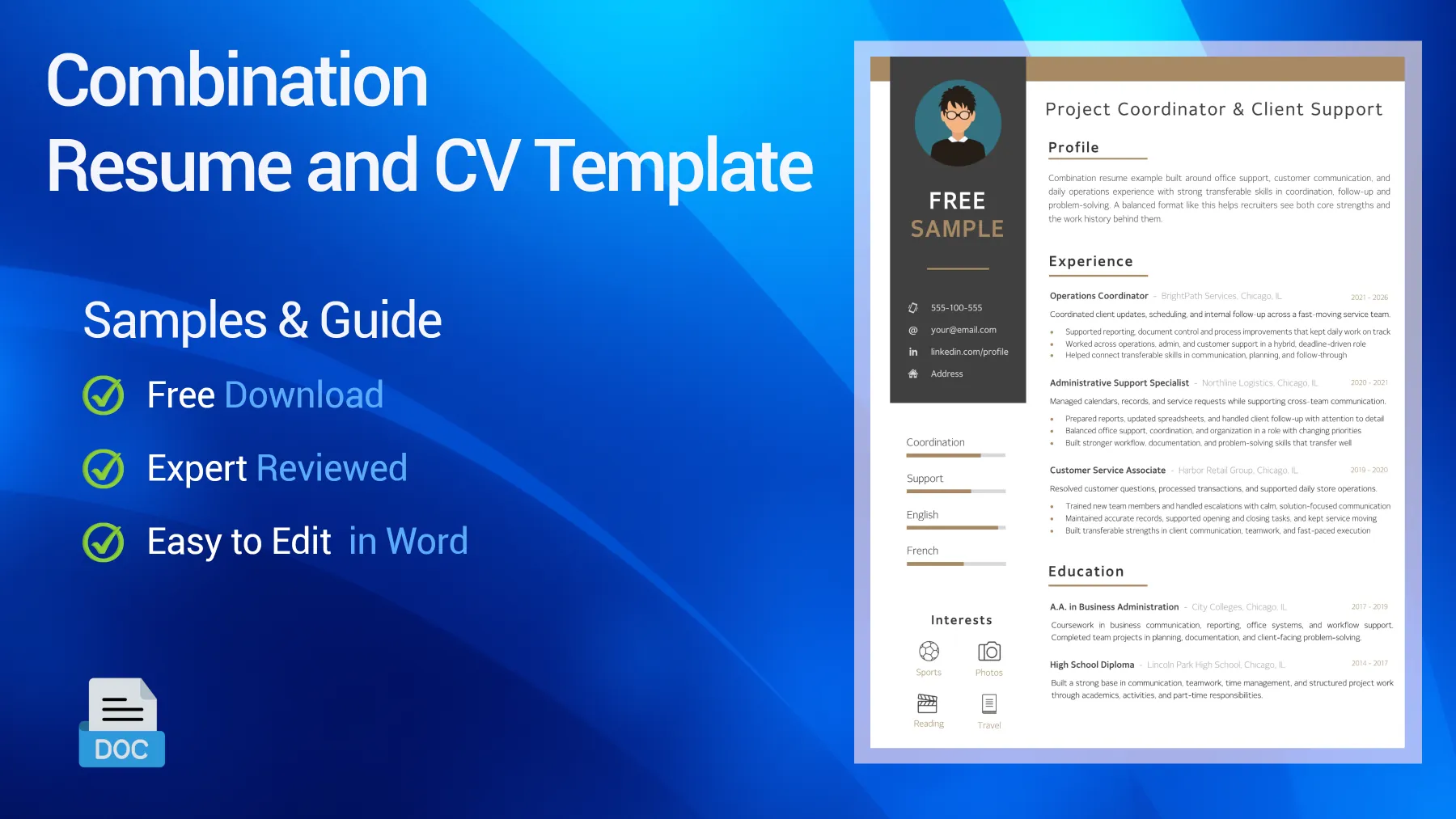
Table of Contents
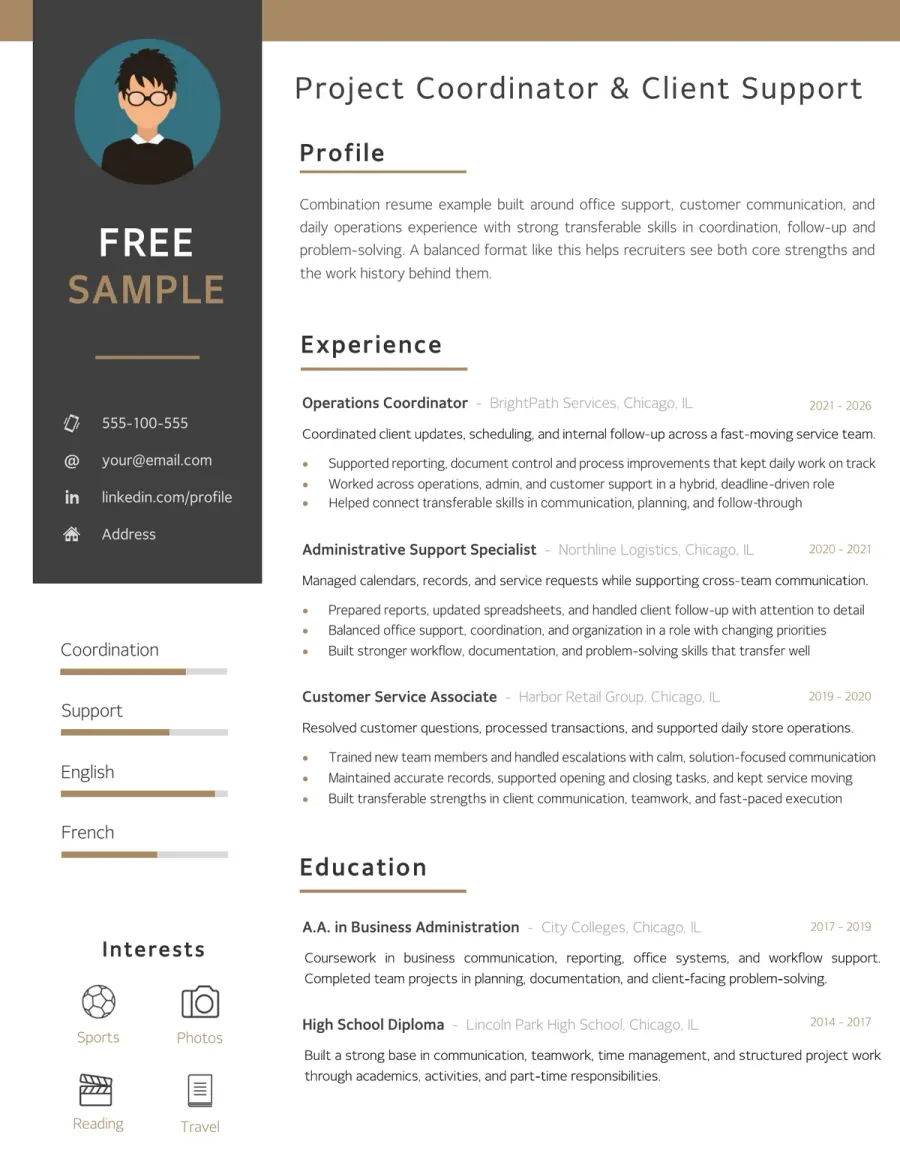
Preview of the Free Combination CV Example You Can Download
Use this editable combination resume template if you want a layout that balances skill clusters with a clear work history. This resume and CV format is especially useful for career changers, candidates with mixed backgrounds, return-to-work applicants, and anyone emphasizing transferable skills. Review the structure first, then download the Word version and customize it to fit your experience.

Reviewed by Daniel K., Resume Consultant
This layout works because it gives the reader two things at once: a quick snapshot of your most relevant skills and enough work history to show where those strengths were developed. That balance makes a combination resume feel practical and trustworthy, rather than evasive.
Who This Combination Resume Template Works Best For
This template is for candidates who need more flexibility than a strictly chronological resume, but more credibility than a skills-only format. Whether you use the term resume or CV, it works best when both transferable skills and job history are important.
- Career changers who need a clearer resume for transferable skills while still keeping enough work history to feel grounded.
- Candidates with mixed experience across different roles, industries, freelance work, volunteering, or projects who need one format that pulls the strongest threads together.
- Return-to-work applicants who want a stronger CV that leads with current value without hiding the timeline completely.
- Professionals with relevant strengths that are not obvious from job titles alone and need a format that explains the real fit more clearly.
- Applicants with broad experience who want to group their strongest abilities first, then support them with a concise and credible work history section.
- Candidates who feel stuck between a chronological resume that undersells them and a functional resume that may raise trust questions.
How to Adapt This Combination Resume Template
A combination resume only works when the balance is intentional. The strongest examples do not simply place a skills section on top of a weak timeline. Instead, they showcase the most relevant skill clusters first, then use the work history to demonstrate where those strengths were developed.
➡️ Read our complete guide to writing a professional CV that stands out
Choose the target role before you build the skill sections
A combination CV should not begin with generic abilities. Start by deciding which role you are targeting, then select the three to four most relevant strengths that should stand out before the recruiter reviews your work history.
See an example
If the target role is operations support, lead with coordination, reporting, communication, and process follow-up. If it is client-facing, move service, relationship management, systems use, and problem-solving higher.
Group the strongest transferable skills together
The first section should make your value easy to understand. Group your skills in a way that feels specific to the role and support each cluster with concrete examples from work, volunteering, projects, or education.
See What to prioritize
Instead of listing communication as a single word, connect it to client updates, stakeholder follow-up, cross-team coordination, or training tasks that show the skill in use.
Keep a concise work history that supports trust
A combination resume still requires a clear employment section. Keep the work history shorter than in a standard chronological CV, but do not leave it out. The timeline gives credibility to your skills section.
See Better phrasing
A brief employment section listing your title, employer, dates, and a few selected bullet points is usually more effective than a resume that never clearly shows where your experience comes from.
Repeat target language naturally across both sections
This format is stronger when the same role-relevant vocabulary appears in both the skills section and work history. Using consistent language gives the resume coherence and makes your fit for the job easier to spot at a glance.
See Quick rule
If the job ad emphasizes scheduling, reporting, and stakeholder communication, those phrases should appear in both your skill clusters and the most relevant experience bullets when they are true for your background.
Keep the balance clean and believable
The page should not feel like two separate resumes stacked together. Let the skills section guide the reader, with the work history supporting it. If one section overshadows the other, the format loses its effectiveness.
See Good direction
A strong combination resume feels selective, role-focused, and easy to read - not like a long chronological CV with an unrelated skills block added at the top.
Keywords Recruiters Often Expect on This Type of Resume
- Transferable skills
- Professional summary
- Relevant experience
- Work history
- Project coordination
- Problem-solving
- Customer communication
- Team leadership
- Training and onboarding
- Cross-functional collaboration
- Administrative support
- Process improvement
- Data accuracy
- Conflict resolution
- Client-facing experience
- Technical skills
- Organizational skills
- Role-specific tools
- Relevant achievements
- Business communication
Do & Don’t - What Makes a Combination Resume Easier to Trust
Recruiters typically form quick opinions about this format. It can feel smart and well-balanced, or it can come across as a workaround for a weak timeline. The strongest versions clarify your skills while maintaining enough chronology to remain credible.
What Weakens This Type of Resume Fast
Red Flags- Using generic skill headings with no proof underneath
- Making the skills section too broad and the timeline too thin
- Repeating the same idea in the summary, skills, and work history
- Hiding the employment section so much that the reader loses trust
- Choosing this format without clearly tying it to the target role
What Makes the Resume Feel Stronger Immediately
Trust Signals- Choose 3 to 4 role-matching skill clusters that deserve extra visibility
- Support each cluster with examples from work, study, projects, or volunteering
- Keep a concise work history section that anchors the experience clearly
- Use the same relevant vocabulary across both skills and chronology
- Keep the layout balanced, readable, and easy to scan in under a minute
FAQ - Combination CV Template
What is a combination resume? Toggle answer
A combination resume blends two priorities: a visible skills section near the top and a shorter, readable work history section below. It works best when both transferable skills and employment chronology are important.
When should I use a combination resume instead of a chronological one? Toggle answer
Use this format when your strongest value is not clear from job titles alone. It can work well for career changes, mixed backgrounds, return-to-work situations, or profiles with transferable skills that should be highlighted up front.
Is a combination resume better than a skills-based resume? Toggle answer
Often, yes - if you want more balance. A pure skills-based format can seem less trustworthy to some recruiters because it minimizes chronology too much. A combination resume usually feels more grounded while still giving extra visibility to your strengths.
Should I still include my full work history? Toggle answer
Not necessarily in full detail. A concise and relevant work history is usually sufficient. The aim is to keep the timeline clear without letting it take over the page.
Can this format work for ATS tools? Toggle answer
Yes, as long as the structure stays simple, section headings remain standard, and role-specific language appears clearly in both the skills and work history sections.
Can I edit this resume template in Microsoft Word, LibreOffice or Google Docs? Toggle answer
Yes, in most cases. The template is designed for easy editing in Word, but it should also work in LibreOffice and Google Docs. Minor spacing or font differences may appear depending on the software.
What to Do Next With This Resume Template
A strong combination resume or CV should make two things clear at once: what you can do now and where those strengths come from. Keep the format balanced, lead with the skill clusters that match the role, and avoid the common mistake of using this structure to hide your timeline instead of supporting it.
The real value of a hybrid format is not cosmetic - it is strategic. Recruiters trust it when the skills section clarifies your message and the work history quietly supports it. That balance is what turns a combination resume into a credible and practical format for job applications.