
Simple One-Page Resume Template for Clear and Easy-to-Scan Applications
This simple one-page resume template lets you present your experience, skills, and qualifications in a clean, concise, and easy-to-scan format. It is designed for candidates who need a professional resume or CV layout that remains readable, focused, and easy to customize without unnecessary visual clutter.
Table of Contents
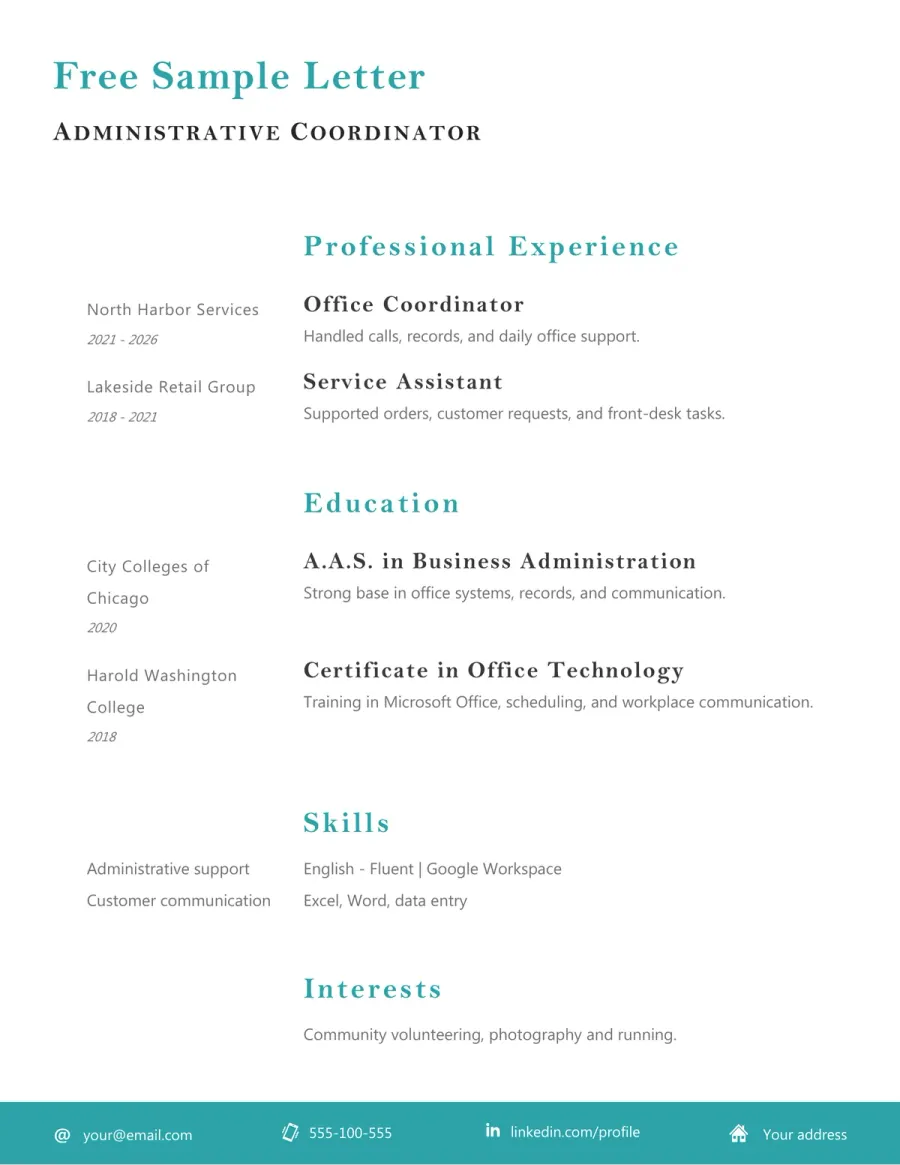
Preview of the Free Simple One-Page CV Example You Can Download
Use this editable simple one-page resume template if you want a layout that is clean, readable, and easy to adapt for straightforward job applications. This resume and CV format works well for concise applications, early-career profiles, return-to-work situations, and any role where clarity matters more than visual style. Review the structure first, then download the Word version and tailor it to your background.

Reviewed by Daniel K., Resume Consultant
This layout works because it does not overcomplicate things. It suits one-page applications, especially when recruiters want a resume that is clear, relevant, and easy to read without decorative distractions or crowded sections.
Who This Simple One-Page Resume Template Works Best For
This template is for candidates who prefer a clear, focused document over a highly designed or lengthy format. Whether you call it a resume or a CV, it works best when employers expect a short, readable, and well-prioritized application.
- Early-career candidates who need a cleaner resume for first serious applications without trying to stretch the content across multiple pages.
- Job seekers with a straightforward work history who want a stronger CV that stays concise and easy to read from top to bottom.
- Candidates returning to the market who need a practical one-page format that highlights the most relevant experience without visual noise.
- Applicants targeting office, service, retail, support, or general professional roles where clarity and relevance matter more than creative presentation.
- Professionals who already know what should stay on the page and want a layout that helps them keep only the strongest information.
- Anyone applying through online systems or recruiter-led processes where a simple, direct, and easy-to-scan resume is usually the safest choice.
How to Adapt This Simple One-Page Resume Template
A one-page resume works best when the content is selective, not cramped. The strongest simple resumes do not try to include everything. They focus on the most relevant information, remove repetition, and help the reader understand your profile quickly and easily.
➡️ For more advice, read our guide on how to write a professional CV
Start by deciding what earns space on the page
A one-page CV cannot include everything. Before rewriting any section, decide what the document needs to prove first, and which details genuinely support that goal.
See an example
If the target role is administrative, keep scheduling, communication, records, and office tools. If the role is customer-facing, move service, sales support, transactions, and problem-solving higher.
Keep the summary short and useful
A simple resume loses impact when the opening paragraph tries to sound impressive rather than helpful. Keep the summary brief, direct, and focused on the role so it adds value without taking up too much space.
See What to prioritize
A short summary that defines your experience level, main strengths, and target role usually works better than a long paragraph with broad claims.
Trim experience down to the strongest proof
One-page resumes require sharper editing. Do not list every task from every job. Use only the bullets that highlight relevant responsibilities, outcomes, tools, or strengths that matter for the job you are applying to.
See Better phrasing
Keep two or three useful bullets with clear value instead of five broad lines that repeat the same idea in different wording.
Let the layout stay simple on purpose
The purpose of this format is not to look plain for lack of ideas; it is to make your content easier to process. Use a clean structure, standard section order, and enough white space so the page feels organized rather than empty.
See Quick rule
A simple one-page resume should feel tight and readable, not crowded, decorative, or stretched just to fill the page.
Tailor the page every time
This format works best when it is specific. Because the page is short, every section must earn its place. Adjust your wording, tools, achievements, and skills to match the exact role instead of relying on a generic version for every application.
See Good direction
Replace weak general lines with role-matching language from the job posting when it reflects your real background and strengths.
Keywords Recruiters Often Expect on This Type of Resume
- Professional summary
- Relevant experience
- Skills section
- Work experience
- Education
- Technical skills
- Microsoft Office
- Customer service
- Administrative support
- Business communication
- Time management
- Organizational skills
- Problem-solving
- Project coordination
- Data accuracy
- Scheduling
- Reporting support
- Documentation
- Teamwork
- Role-specific keywords
Do & Don’t - What Makes a Simple Resume Easier to Trust
Recruiters usually react quickly to simple resumes; they either feel sharp and well-edited or too thin and generic. The strongest examples stay concise while still providing enough proof to feel useful and credible.
What Weakens This Type of Resume Fast
Red Flags- Trying to force too much detail into one page until the layout feels cramped
- Using a vague summary that takes space without adding value
- Keeping weak or repetitive bullets just to make the resume look fuller
- Making the design look plain while the content stays generic
- Leaving out important keywords because the format is meant to be short
What Makes the Resume Feel Stronger Immediately
Trust Signals- Keep only the experience, skills, and tools that support the target role
- Use short sections and readable bullets instead of dense text blocks
- Write a brief summary that defines the profile clearly
- Let the page feel clean, selective, and easy to scan
- Make every line earn its place on the page
FAQ - Simple One-Page CV Template
Who should use a one-page resume? Toggle answer
It is often a strong choice for students, recent graduates, early-career candidates, and many applicants with a focused or straightforward background. It can also work well for experienced professionals when only the most relevant information should be included.
Is a simple resume too basic for serious jobs? Toggle answer
No. In many cases, simple is what makes a resume feel more professional. A clear, well-edited one-page format often performs better than a busier design when recruiters need to review resumes quickly.
What should I remove to keep a resume on one page? Toggle answer
Usually: older or less relevant experience, repetitive bullet points, generic soft skills, long summaries, and any details that do not support the target role. The goal is to keep what adds real value and cut what just takes up space.
Can a one-page resume still work for ATS tools? Toggle answer
Yes, as long as you use standard headings, readable text, and relevant keywords. Simple one-page formats often work well because they are easier for ATS tools to parse and for recruiters to scan.
Is this template better than a professional or ATS-friendly resume template? Toggle answer
Not necessarily. It is better when your priority is clarity, brevity, and a clean one-page layout. More formal or ATS-driven applications might benefit from those other templates, depending on the role.
Can I edit this resume template in Microsoft Word, LibreOffice or Google Docs? Toggle answer
Yes, in most cases. The template is designed to be easy to edit in Word, but it should also work in LibreOffice and Google Docs. Minor spacing or font differences may appear depending on the software.
What to Do Next With This Resume Template
A strong simple one-page resume or CV should quickly communicate what matters most about your profile and leave out the rest. Keep the layout clear, keep the content selective, and avoid the common mistake of confusing “short” with “weak.”
With this type of application, credibility comes from focus. Recruiters notice when your resume highlights the right experience, skills, and keywords without wasting space. That is what gives a simple one-page resume real weight.