
How to Write a Speech or Toast That Sounds Natural
A speech works when the room can follow it the first time they hear it. This guide helps you choose the right structure, tone and length for a toast, tribute, wedding speech, birthday speech, eulogy, graduation address or professional remarks—without sounding copied, stiff or out of place for your audience.
What Makes a Speech Work Out Loud?
A speech is not a letter read into a microphone. People can reread written text, but a speech has to land the first time, while the audience is listening, reacting, thinking about the moment and often waiting for what comes next.
That is why a good speech or toast needs fewer ideas than most people expect. One purpose. One clear role. One audience. One memory, proof point or example. One ending the room can understand without having to reread anything.
The best speeches feel prepared, but not so polished that they sound unnatural. They use short paragraphs, natural transitions and details that fit the person, event or room. They do not try to say everything. They choose what matters most and make it easy to hear.
Speech, Toast, Tribute or Opening Remarks
Before you write, decide on the format. Many weak speeches fail because the writer mixes formats: a toast turns into a long tribute, a welcome speech becomes a full event report or a eulogy starts to sound like a motivational address.
| Format | Best for | Typical length | Ending |
|---|---|---|---|
| Toast | Wedding, birthday, retirement dinner, family celebration | 30 seconds to 2 minutes | Raise a glass or share one clear wish |
| Speech | Wedding reception, graduation, business launch, formal event | 3 to 6 minutes | Closing thought, wish, thank-you or next step |
| Tribute | Milestone birthday, retirement, memorial, eulogy | 3 to 5 minutes | Gratitude, remembrance or a respectful farewell |
| Opening remarks | Welcome, meeting, association event, launch, ceremony | 1 to 3 minutes | Introduce what happens next |
The format does not lock you into a strict word count. It gives you direction. A toast does not need to explain everything. A tribute should not rush the person out of the room. Opening remarks should welcome people and move the event forward, not become the main speech.
Before You Write: Room, Role and Risk
Writing your speech gets easier when you stop asking, What should I say? and ask three better questions: Who am I in this room? Who is listening? What could make this moment awkward?
Your role changes the speech. A best man speaks as a friend of the groom. A maid of honor speaks from the bride’s side. A parent speaks with family history. A retiree speaks from inside the career. A manager speaks on behalf of a workplace. A eulogy speaker speaks with the family’s grief in the room.
The audience sets the boundaries. A joke that works among close friends may fall flat in front of grandparents, colleagues or children. A memory that feels funny to you may feel uncomfortable for the person being honored. A sentence that seems sincere on the page can sound too heavy aloud.
Before drafting, write one plain sentence for yourself: I am speaking as [Role], to [Audience], because [Occasion], and I want the room to feel [Effect]. If you cannot complete that sentence, your speech is not ready to write yet.
A Simple Speech Structure
You do not need a complicated structure. Most speeches follow the same simple path: orient the room, establish your relationship, share one clear detail, explain why it matters, turn back to the audience or person being honored and then close cleanly.
Think of it as a spoken path, not a fill-in-the-blank template. Every part should earn its place. If the occasion is light, move quickly. If it is emotional, leave more room to breathe. If it is professional, make the purpose and next step clear.
A useful structure is: Opening - Relationship - One story or proof point - Meaning - Turn outward - Closing. The story is not there just to entertain. It gives the room proof. The meaning explains why the detail matters. The turn outward makes sure the speech does not stay trapped inside your own experience.
How to Write a Speech or Toast Step by Step
Follow these steps before choosing a sample. They will help you build a speech that fits your occasion instead of sounding like a generic script with different names inserted.
Name the exact occasion
Do not write “a speech” in the abstract. Write for the real moment: wedding reception, 50th birthday dinner, memorial service, graduation ceremony, retirement lunch, business launch or welcome session.
See Why it matters
The occasion sets the risk level. A best man toast can be playful. A eulogy needs restraint. A business launch calls for clarity and credibility.
Define your role in one sentence
Your role shapes your voice. A parent, friend, manager, graduate, retiree or host should not sound the same, even when they are speaking at the same event.
See Try this
I am speaking as [Role], to [Audience], because [Occasion], and I want the room to feel [Effect].
Choose one main idea
The audience should leave remembering one thing clearly. Friendship. Gratitude. Pride. Welcome. Resilience. New beginning. Service. Love. Choose the core message before you start writing.
Select one story, memory or proof point
Use one detail that shows your point instead of simply describing it. The story should feel safe for the room and be easy to understand without private background.
See Useful pattern
Memory -> quality -> meaning -> return to the room.
Turn the speech outward
A speech should not stay only inside your own feelings. Bring the room back to the couple, family, team, graduates, guests, community or person being honored.
Write a closing line before you polish anything else
The ending sets the destination. A toast needs a line people can raise a glass to. A eulogy needs a respectful farewell. A launch needs a clear next step. A welcome speech needs a transition.
Read it aloud and cut what does not survive
The read-aloud test is not optional. If a sentence is hard to say, too long to breathe through or too polished to sound human, rewrite it.
Start a Speech Naturally
The opening should help the room feel oriented, not try to impress. Avoid long apologies, famous quotes that do not fit the occasion, dictionary definitions and jokes that need too much explanation.
A good opening usually does one of four things: identifies your role, welcomes the room, names the emotion of the moment or gives the audience a simple reason to listen. Being direct is often better than being clever.
Once your opening works, move on. Many speeches lose energy because the speaker spends too long explaining why they are nervous, honored or unsure what to say. The room already understands that speaking can be difficult. Give them the speech.
Use One Story Without Losing the Room
One story is usually enough. Two can work if the speech is longer and both stories serve different purposes. Three is where many speeches start to drag.
The safest story is specific, short and generous. It should show a quality the room can recognize: loyalty, courage, humor, patience, kindness, steadiness, curiosity, resilience, generosity or the ability to make people feel included.
Before keeping a story, ask yourself: Will this memory still make sense to someone who was not there? If the answer is no, either explain it briefly or choose another memory. Inside jokes are not automatically personal. Sometimes they are just confusing for everyone else.
A simple story pattern is: memory - quality - meaning - return to the room. The memory gives shape. The quality explains why the memory matters. The meaning connects it to the occasion. The return brings the speech back to the couple, graduate, retiree, family, team or guests.
Speech and Toast Length
There is no perfect length for every speech. The right length depends on your role, the room, how many people are speaking and the emotional weight of the moment. Practical ranges still help you avoid the most common mistake: writing for the page instead of the microphone.
| Occasion | Useful range | Why |
|---|---|---|
| Short toast | 100 to 250 words | Enough for one wish and one small detail |
| Full wedding speech | 650 to 850 words | Enough for one story, a couple-focused turn and a toast |
| Eulogy or memorial tribute | 500 to 750 words | Enough for memory, character and farewell without overwhelming the service |
| Graduation or business speech | 700 to 1,100 words | Enough for audience, purpose, thanks and forward motion |
| Welcome or opening remarks | 250 to 600 words | Enough to orient the room before the main program begins |
Treat those ranges as guidance, not law. A strong two-minute toast is better than a five-minute speech that repeats itself. If several people are speaking, keep yours shorter. If the moment is delicate, do not rush it, but do not ask the room to carry more than it needs to.
Tone by Occasion
The structure may stay similar, but the tone should shift by occasion. A birthday speech can carry humor. A eulogy must protect the family. A business launch needs credibility. A wedding speech needs warmth and room-safe humor. A graduation speech should include families and teachers, not only graduates.
| Occasion | Tone that usually works | What to avoid |
|---|---|---|
| Wedding | Warm, light, couple-focused | Exes, adult jokes, private embarrassment |
| Birthday | Affectionate, age-aware, lively | Making the whole speech about age |
| Eulogy | Restrained, truthful, family-aware | Explaining the loss or forcing comfort |
| Graduation | Proud, inclusive, forward-looking | Generic motivation with no shared detail |
| Retirement | Grateful, respectful, not final | Age jokes, bitterness, full career timeline |
| Business launch | Clear, credible, focused on value | Reading a sales deck aloud |
| Welcome speech | Warm, orienting, practical | Long mission statements or internal jargon |
A safe rule: if the speech is about another person, protect them. If it is about a group, include the people behind the work. If it is about a loss, do not try to solve grief. If it is about a new beginning, make the next step visible.
Choose the Right Speech Sample for Your Occasion
The guide gives you the method. Use a dedicated sample only when you need a complete model for a specific occasion. This keeps the guide focused on structure while helping you find the right example when you are ready to adapt it.
- Best man speech and wedding toast sample: use one safe story about the groom, turn clearly toward the couple and end with a toast guests can share.
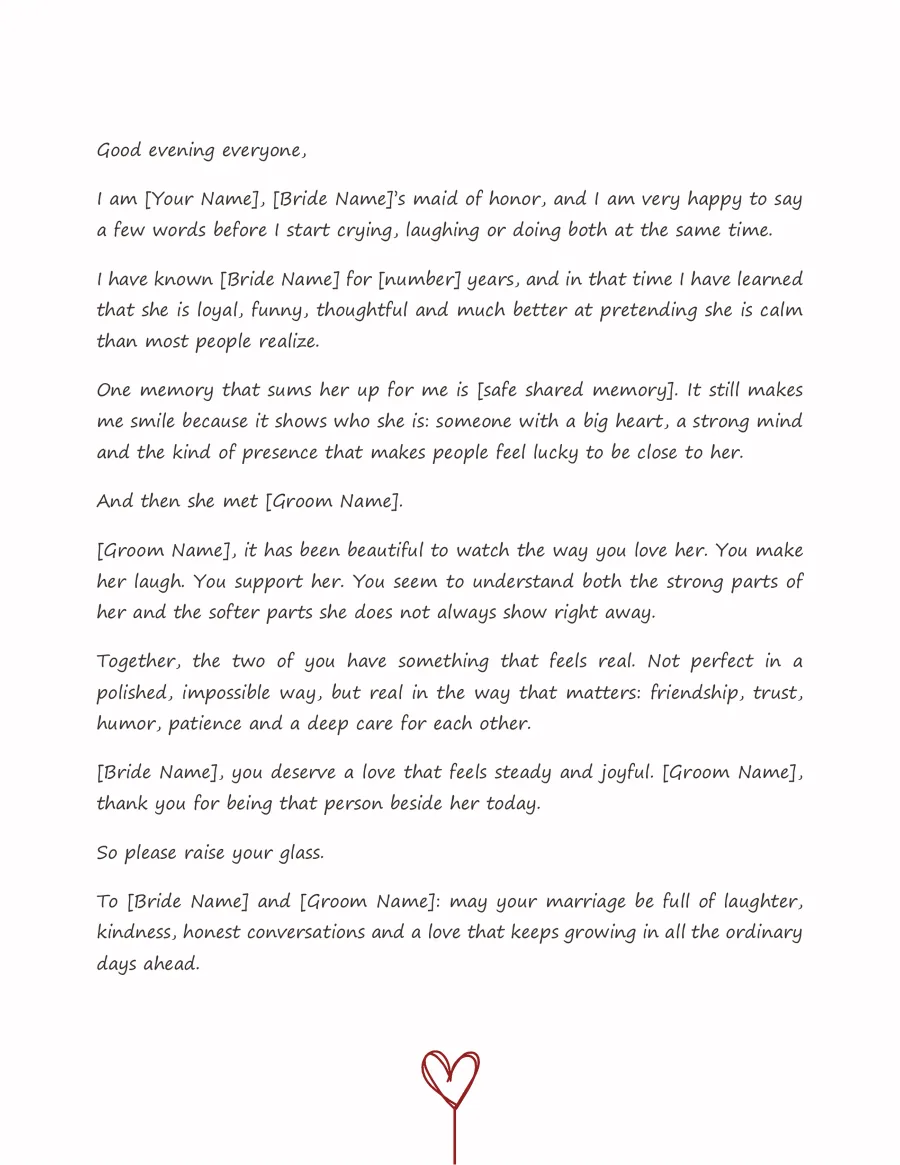
- Maid of honor speech for the bride’s side: focus on the bride, include the spouse with warmth and avoid turning the speech into a private friendship letter.
- Parent wedding speech for the bride or groom: share one family memory, welcome the new spouse and keep advice short enough to feel like love rather than a lecture.
- 50th birthday speech for a major milestone: match the age to the tone. A milestone birthday needs humor and perspective, but it should not reduce the person to their age.
- Eulogy for a friend and funeral tribute sample: choose one memory, one quality and one careful goodbye. Do not try to explain grief or summarize a whole life.
- Graduation speech and commencement remarks: include graduates, families and teachers. Use one shared memory or theme, then look forward without sounding like a motivational poster.
- Retirement speech and farewell toast: give one work memory, one reason the person or team mattered and a forward-looking farewell that makes retirement feel earned, not final.
- New business launch speech and opening remarks: explain why the business, product or project exists, thank the people behind it and close with a practical next step.
- Welcome speech for new employees, members or volunteers: make new employees, members, volunteers or guests feel expected, explain the purpose and tell the room what happens next.
- Thanksgiving speech and gratitude toast: name one reason to be thankful, one group of people to recognize and one hope for the season or year ahead.
Humor, Emotion and Sensitive Topics
Humor can help a room relax, but it is not required. Emotion can make a speech memorable, but it should not turn the moment into a private confession. The strongest speeches usually handle both with restraint.
Good humor is generous. It makes the person or group feel recognized, not reduced. It can come from a harmless habit, a shared situation, a known phrase, the chaos of planning an event or the gap between what people expected and what actually happened.
Unsafe humor usually targets the wrong thing: past relationships, drinking stories, body, money, grief, family conflict, religion, private mistakes, age decline or anything the person would not want repeated later. If you are not sure whether a joke is safe, cut it. You will not regret removing one risky line.
Emotion works best when it is specific. Instead of saying you are overwhelmed, show one reason the moment matters. Instead of trying to make everyone cry, give the room one true detail and leave space for people to feel what they feel.
Write for the Ear, Not the Page
A speech should look almost too simple on the page. That is a good sign. Spoken language needs shorter units, clearer turns and more breathing room than written prose.
Use short paragraphs. Put important lines on their own. Avoid sentences that require the listener to wait too long for the point. Replace stacked clauses with two cleaner sentences when the meaning is practical.
Read the draft aloud before you edit it. You will hear problems the page hides: repeated phrasing, jokes that take too long, emotional lines that sound too polished, transitions that feel mechanical and paragraphs that leave you out of breath.
Print the final version in a readable size. Add line breaks where you need to pause. Mark names, toasts and transitions clearly. A speech can be well written and still fail if the speaker cannot deliver it comfortably.
Preview of the Speech Writing Guide You Can Download
Below is a preview of the speech writing guide you can download and use before writing a toast, tribute, wedding speech, birthday speech, graduation remarks or professional address.
What Every Speech Needs Before You Read It Aloud
- Purpose
- Audience
- Speaker Role
- Occasion
- One Clear Structure
- One Story or Proof Point
- One Visible Quality
- Room-Safe Humor
- Tone Matched to the Moment
- Short Paragraphs
- Natural Opening
- Clear Transition
- Final Toast or Closing Line
- Read-Aloud Practice
- Backup Shorter Version
Do & Don’t - Writing a Speech People Can Actually Listen To
A speech is heard in real time. The strongest version gives the room a path to follow, protects the people involved and ends before the audience starts wishing it had been shorter.
What Makes a Speech Feel Awkward
Red Flags- Start with a long apology or a borrowed quote
- Try to tell the whole story of a life, friendship, career or event
- Keep a second or third anecdote when the first one already proves the point
- Use private jokes the room cannot follow
- Make the speech mainly about yourself
- Force humor into a sensitive moment
- Keep decorative quotes, risky jokes or explanations that only matter to people who were there
- End without a clear toast, thank-you, farewell or next step
What Makes the Speech Land Better
Trust Signals- Define your role before writing
- Choose one memory or proof point
- Keep the audience in the room
- Match the tone to the occasion
- Write short paragraphs for speaking
- Practice aloud and cut what does not survive the read-aloud test
FAQ - Writing a Speech or Toast
How do I start a speech? Toggle answer
Start by orienting the room. Say who you are if needed, name the occasion and move quickly to the person, group or moment being honored. Avoid long apologies, dictionary definitions and quotes that do not fit the occasion.
What is the best structure for a speech? Toggle answer
A simple structure works for most occasions: opening, relationship or context, one story or proof point, meaning, turn outward and closing. Adjust the tone and length to the event rather than forcing every speech into the same mold.
How long should a speech or toast be? Toggle answer
A short toast can be 100 to 250 words. A full wedding speech often works at 650 to 850 words, while a graduation or business speech may need 700 to 1,100 words. Use the occasion-specific ranges above as guidance, then adjust for your role, the number of speakers and the room.
How do I make a speech sound personal? Toggle answer
Use one real memory, habit, phrase, work moment or shared detail that shows the person or occasion clearly. Personal does not mean private. Choose details the room can understand and the people involved would feel safe hearing.
Can I use humor in a speech? Toggle answer
Yes, if the humor is generous and safe for the room. Use light teasing, shared situations or harmless habits. Avoid exes, adult jokes, drinking stories, grief jokes, private conflict, age decline or anything that would expose someone.
What should I avoid in a speech? Toggle answer
Avoid trying to say everything, using too many anecdotes, making the speech mainly about yourself, relying on private jokes, forcing emotion and ending without a clear final line. If a sentence feels risky when read aloud, cut it.
How do I end a toast? Toggle answer
End with a short wish the room can share. A wedding toast may wish love and laughter. A retirement toast may wish health and a joyful next chapter. A birthday toast may wish another year of memories, friendship and celebration.
Should I memorize my speech? Toggle answer
You do not need to memorize every word. It is usually safer to know the structure well, practice aloud and keep a printed version with short paragraphs. Memorizing too tightly can make a speech sound less natural or become stressful if you lose your place.
Download the Speech Writing Guide
Want the method in one place before you write? Download this speech writing guide as a PDF, then choose the sample that matches your occasion.
TL;DR - Write the Speech for the Room, Not the Page
A strong speech or toast does not need to cover everything. It needs a clear role, one idea, one specific detail and a final line that fits the occasion. The most common mistake is writing too much because the moment feels important. But importance usually needs better selection, not more words.
Before delivering the speech, read it aloud and cut anything too private, too generic, too long or too hard to say. If the room can follow you the first time, recognize the person or event clearly and feel the ending land, your speech is doing its job.