
Fitness Trainer Cover Letter Examples Recruiters Respect in 2026
Recruiters don't hire fitness trainers just for their energy. They want to see safe coaching, client progress, and member trust. The examples below show how to build a cover letter grounded in real training experience.
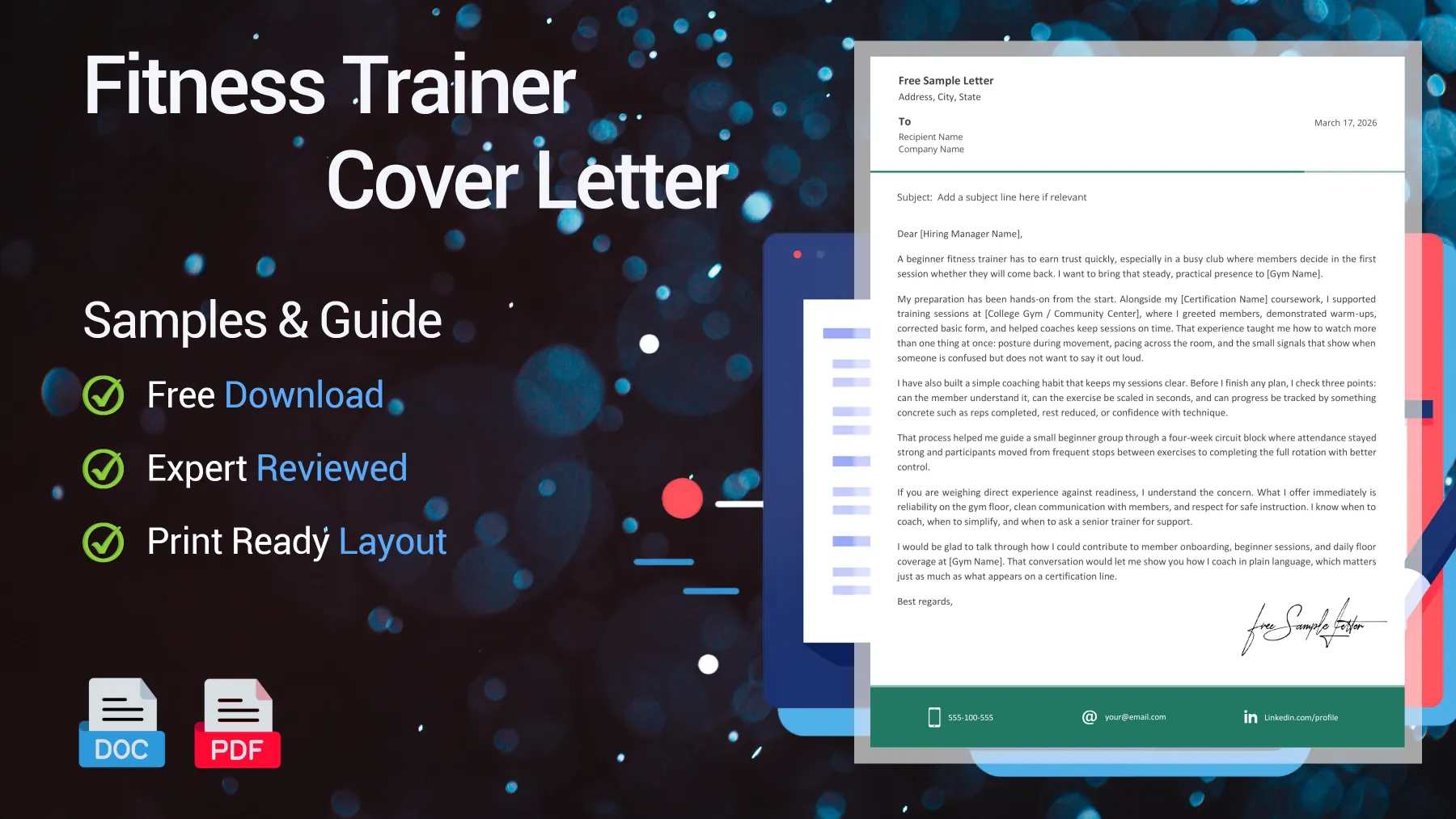
Free Fitness Trainer Cover Letter Samples for Your Application
The Bureau of Labor Statistics projects a 12% growth in fitness trainer jobs from 2024 to 2034. But more job openings won't make hiring easier - your cover letter still needs to show evidence of safe coaching, client progress, and the ability to adapt programs.
Beginner Fitness Trainer Cover Letter for Gym Floor Roles
A junior fitness trainer often needs proof of readiness more than proof of seniority. This sample builds that case through certification, clear communication, and realistic gym-floor responsibilities.
Dear [Hiring Manager Name],
As a beginner fitness trainer, I know earning trust quickly is essential, especially in a busy club where members often decide after the first session whether they will return. I aim to bring that steady, practical presence to [Gym Name].
My approach has been hands-on from the beginning. During my [Certification Name] coursework, I assisted with training sessions at [College Gym / Community Center], greeting members, demonstrating warm-ups, correcting basic form, and helping coaches keep sessions on schedule. That experience taught me to monitor multiple things at once: posture during movement, pacing across the room, and subtle signs when someone is confused but hesitant to speak up.
I have also developed a straightforward coaching habit to keep sessions clear. Before finalizing any plan, I check three things: is it easy for the member to understand, can the exercise be scaled quickly, and can progress be tracked by something concrete, like reps completed, rest time reduced, or improved confidence with technique?
This approach helped me guide a small group of beginners through a four-week circuit block, where attendance remained strong and participants progressed from frequent stops to completing the full circuit with better control.
If you are weighing direct experience against readiness, I understand the concern. What I offer right away is reliability on the gym floor, clear communication with members, and respect for safe instruction. I know when to coach, when to simplify, and when to seek guidance from a senior trainer.
I would be happy to discuss how I could support member onboarding, beginner sessions, and day-to-day floor coverage at [Gym Name]. I believe a conversation is the best way to show you how I coach in plain language, which matters just as much as what is on my certification.
Best regards,
[Your Name]

Reviewed by Claire M., Career Coach
I like how the objection about limited experience is handled without sounding defensive. The process behind the coaching already feels practical and usable.
Experienced Fitness Trainer Cover Letter
Written for a senior fitness trainer with deep gym-floor experience, this cover letter connects coaching results, member loyalty, and operational judgment in a way hiring managers can measure.
Dear [Hiring Manager Name],
Member results are only half the job. In a strong fitness department, success is measured by whether clients stay, progress safely, and continue to trust the coaching team over time. That is the standard I have worked to uphold throughout my career, and it is why the fitness trainer role at [Gym Name] interests me.
Over the past [number] years, I have coached one-on-one clients, small groups, and open-floor members in general fitness, weight loss, and return-to-training programs. In my current position at [Current Gym Name], I manage a client base of about [number] active members and maintain a retention rate above [number]%. I achieve this by creating programs people can stick with in real life, rather than chasing the latest trends.
Every plan starts with a movement assessment, discussion of training history, schedule constraints, and an honest conversation about what the client can realistically maintain. This approach has helped clients improve consistency, reduce missed sessions, and achieve measurable goals such as [number] pounds lost, stronger core lifts, or a return to pain-free training.
The quickest way I can add value at [Gym Name] is by strengthening the connection between coaching quality and member loyalty. For example, last quarter I redesigned our onboarding process for new personal training clients by adding a clearer first-month roadmap, shorter progress reviews, and simple follow-up notes after each session. As a result, personal training renewals increased by [number]% and fewer clients dropped off after their initial package.
I also contribute to the team. I have onboarded junior trainers, shared programming templates, and stepped in when schedules changed or class sizes increased at short notice. On a busy floor, good judgment is just as important as technical knowledge. Members appreciate trainers who can coach technique, adjust for limitations, and maintain a professional atmosphere without turning every session into a performance.
I would welcome a conversation about how I could support client retention, coaching quality, and trainer development at [Gym Name].
Sincerely,
[Your Name]
Reviewed by Claire M., Career Coach
I see a trainer who understands both client progress and team standards. That balance makes the application feel senior without sounding inflated.
Fitness Trainer Cover Letter for a Coaching Internship Placement
Written for a student in coach training, this version turns coursework, observation hours, and member contact into a fitness trainer cover letter that feels credible without paid experience.
Dear [Hiring Manager Name],
The best training placements are not about watching from the sidelines. They are about learning the pace of a real gym, understanding what members need in the moment, and becoming useful without disrupting the flow. That is exactly why I am applying for a fitness trainer placement with [Gym Name] as part of my [Course Name] program.
My training has given me a solid foundation in exercise technique, warm-up structure, movement screening basics, and safe progression for beginners. During my course, I practiced explaining core lifts, mobility drills, and basic conditioning in clear language. I also completed CPR/AED training and logged [number] observation hours at [Gym / Studio Name], where I saw trainers handle first assessments, correct form on the floor, and adapt sessions when a client needed a simpler option.
One experience made the job feel real to me: a new member looked ready to quit halfway through a circuit, embarrassed by his pace. The trainer shortened the interval, changed one station, and kept talking to him as if nothing was wrong. That member finished the session and booked the next one. It stuck with me because it showed that good coaching is not just technical - it is about timing, judgment, and protecting someone’s confidence while maintaining high standards.
What I can offer [Gym Name] immediately is reliability, attention, and a genuine willingness to support the team. I can help prepare equipment, welcome members, demonstrate basic movements, keep training areas clean, and learn quickly from feedback. I am not applying as someone who knows everything. I am applying as someone ready to be useful, observant, and coachable from day one.
I would appreciate the chance to discuss how this placement could support your team while providing the right environment for me to grow into a strong fitness trainer.
Sincerely,
[Your Name]
Reviewed by Claire M., Career Coach
I like that the candidate does not hide behind coursework. The letter shows observation, safe coaching habits, and a clear reason to bring them in.
Fitness Trainer Template Preview Before Word or PDF Download
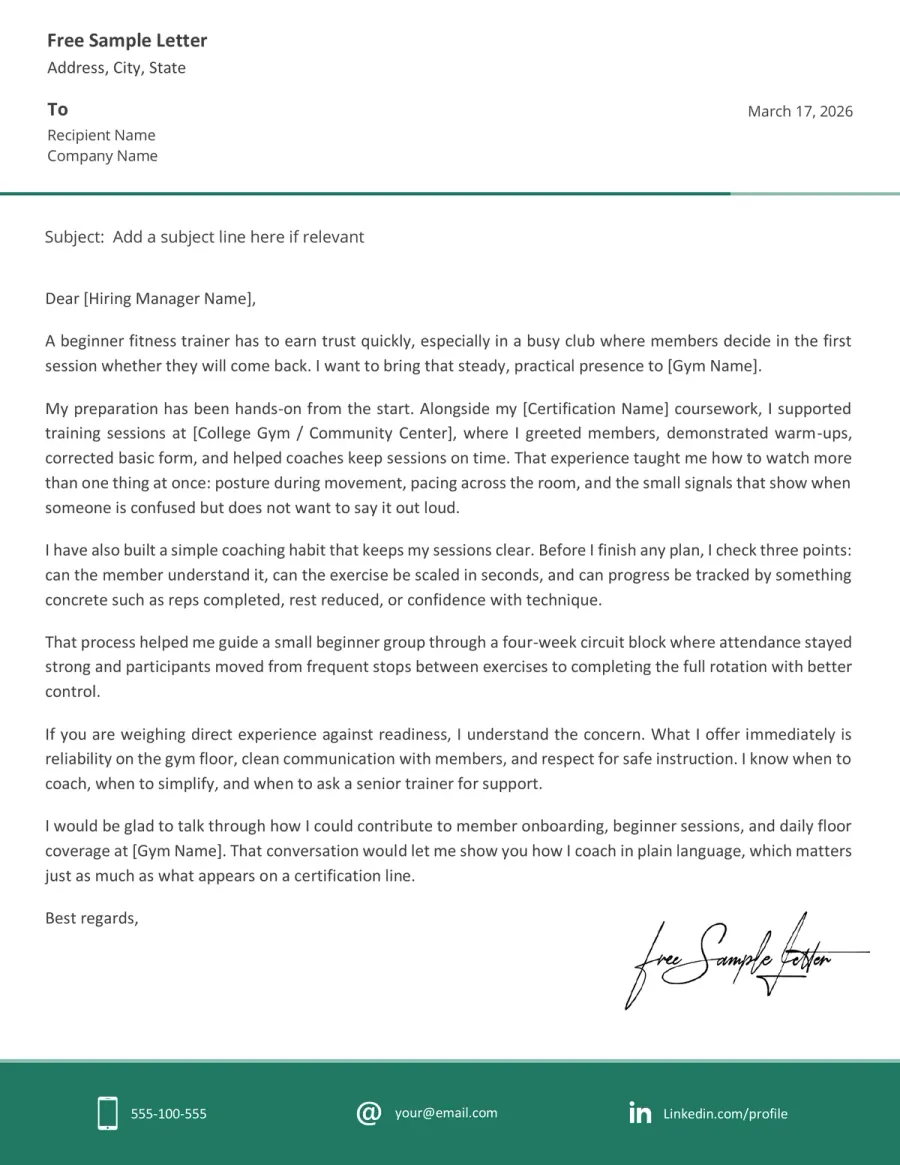
Preview the fitness trainer cover letter template before downloading it as a Word or PDF file. This quick view lets you check the layout, tone, and overall structure before starting your application.
Turn These Fitness Trainer Samples Into Your Own
Copy-paste cover letters are easy to spot in fitness hiring. Coaches see generic applications every week. Personalize these samples to reflect your own training approach, client results, certifications, and the specific types of members or classes the club serves.
➡️ More expert advice in our article how to write a cover letter that sounds personal and job-ready
Match the training setting
Begin by identifying the specific setting of the role - whether that is the gym floor, a boutique studio, or corporate fitness. This choice shapes your vocabulary, examples, and how much you focus on commercial results in your letter.
See an opening line
At [Gym Name], members are looking for structured coaching they can trust, from first assessment to consistent follow-up. That is where I know I can add value from day one.
Swap claims for proof
Swap out general claims for proof the hiring manager can visualize. Reference a specific client result, coaching scenario, or an improvement in attendance, technique, confidence, or program adherence.
See what to include
I rebuilt a beginner client’s plan around shorter sessions and clearer progress checks, which helped her return twice a week consistently instead of dropping out after week two.
Adjust the level of experience
Align your skills to the job level. For entry-level roles, focus on safe coaching, clear communication, and a willingness to learn. For senior positions, highlight retention, member progress, and your influence on the team.
See the shift
A junior version might mention CPR/AED, floor support, and beginner cueing, while a senior version can mention client renewals, assessment reviews, and mentoring newer trainers.
Tune the tone to the brand
Adjust your language to fit the gym’s brand. High-end clubs may expect more polished language and an emphasis on member retention. Community gyms often value clarity, warmth, and a clear commitment to supporting members.
See a tone change
Saying "I help clients stay consistent through simple progress markers and practical coaching" feels very different from "I build premium training experiences anchored in review, progression, and retention."
End with a real next step
End with a next step that fits the role. A strong closing invites a conversation about your coaching style, understanding member needs, scheduling, or how you would support the floor team.
See a closing move
I would value the chance to discuss how I could support new member onboarding, client retention, and day-to-day floor standards at [Gym Name].
Fitness Trainer Keyword Radar for Recruiters and ATS
- Program design
- Member retention
- Form cues
- Client outreach
- Initial assessments
- CPR/AED
- Small-group coaching
- Session progression
- Goal tracking
- Technique correction
- Safe exercise scaling for mixed-ability groups
- Onboarding new members
Do & Don’t for a Fitness Trainer Cover Letter That Feels Credible
Fitness hiring moves quickly. Recruiters look for evidence you can coach safely, keep members engaged, and fit the gym’s culture. A weak letter feels generic right away; a strong one shows good judgment, practical details, and an understanding of the role.
Fitness Trainer Cover Letter Red Flags
Red Flags- Lead with vague enthusiasm and no coaching context
- List certifications without showing how you coach on the floor
- Sound identical to every gym application on the pile
- Overload the letter with biography instead of job relevance
- Close with a flat line that adds no next step
Fitness Trainer Cover Letter Trust Signals
Trust Signals- Show one concrete coaching scene the reader can picture
- Mention assessments, progression, retention or class delivery naturally
- Use job-specific language without turning the letter into jargon
- Match the tone to the type of club and clientele
- End by pointing to a practical conversation about the role
FAQ - Fitness Trainer Cover Letter
Can I apply as a fitness trainer if I only have a certification and no paid clients yet? Toggle answer
Yes. Your letter should demonstrate your readiness, not exaggerate experience. Mention CPR/AED certification, observation hours, beginner cueing, and include a real example of adapting an exercise or keeping a participant engaged.
Should I mention CPR/AED even if the ad does not list it clearly? Toggle answer
Yes. CPR/AED is an important trust signal in fitness hiring. Do not just list it as a credential - connect it to your ability to coach safely, build member confidence in their first session, or handle gym-floor responsibilities.
I teach group classes, not one-to-one PT. Does that still help my application? Toggle answer
Absolutely. Highlight how your group class experience translates into pacing, exercise demonstrations, room awareness, and live corrections. Add a line showing you can individualize training when a member needs extra support.
Do gym managers care about sales and retention, or only coaching? Toggle answer
Usually both. Many trainer roles involve assessments, follow-ups, client renewals, and member retention. Your letter should prioritize coaching, but also show that clients return because of your approach.
Should I mention my own physique or personal fitness journey in the letter? Toggle answer
Only mention it briefly, if at all. Hiring managers are not interested in your personal fitness journey - they want to see you can coach others safely, clearly, and consistently.
TL;DR - What Makes a Fitness Trainer Cover Letter Worth Reading
A strong fitness trainer cover letter quickly shows three things: you can coach safely, you adapt sessions to real people, and you understand that member progress matters more than gym-floor hype. The biggest mistake is making the letter about your own fitness journey, instead of focusing on the client experience.
The key is judgment. Recruiters notice when a candidate sounds like someone who can assess, adjust, follow up, and keep members coming back. The best application letter does not just sound fit - it sounds dependable, commercially aware, and trustworthy with real people.